Weed-Induced Crop Losses - Agriculture Allied Sector | UPSC Learning
Topics
0 topics • 0 completed
🔍
No topics match your search
Weed-Induced Crop Losses
Medium⏱️ 7 min read
agriculture allied sector
📖 Introduction
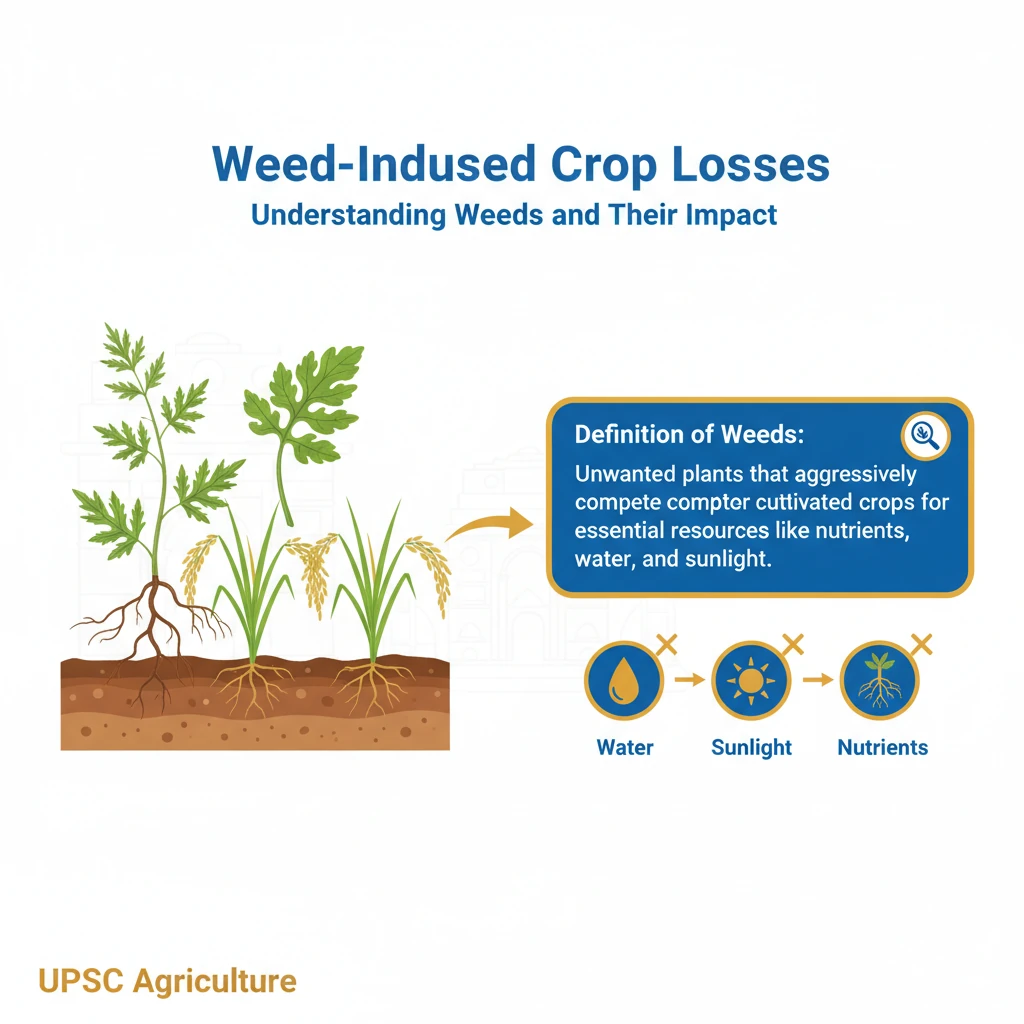
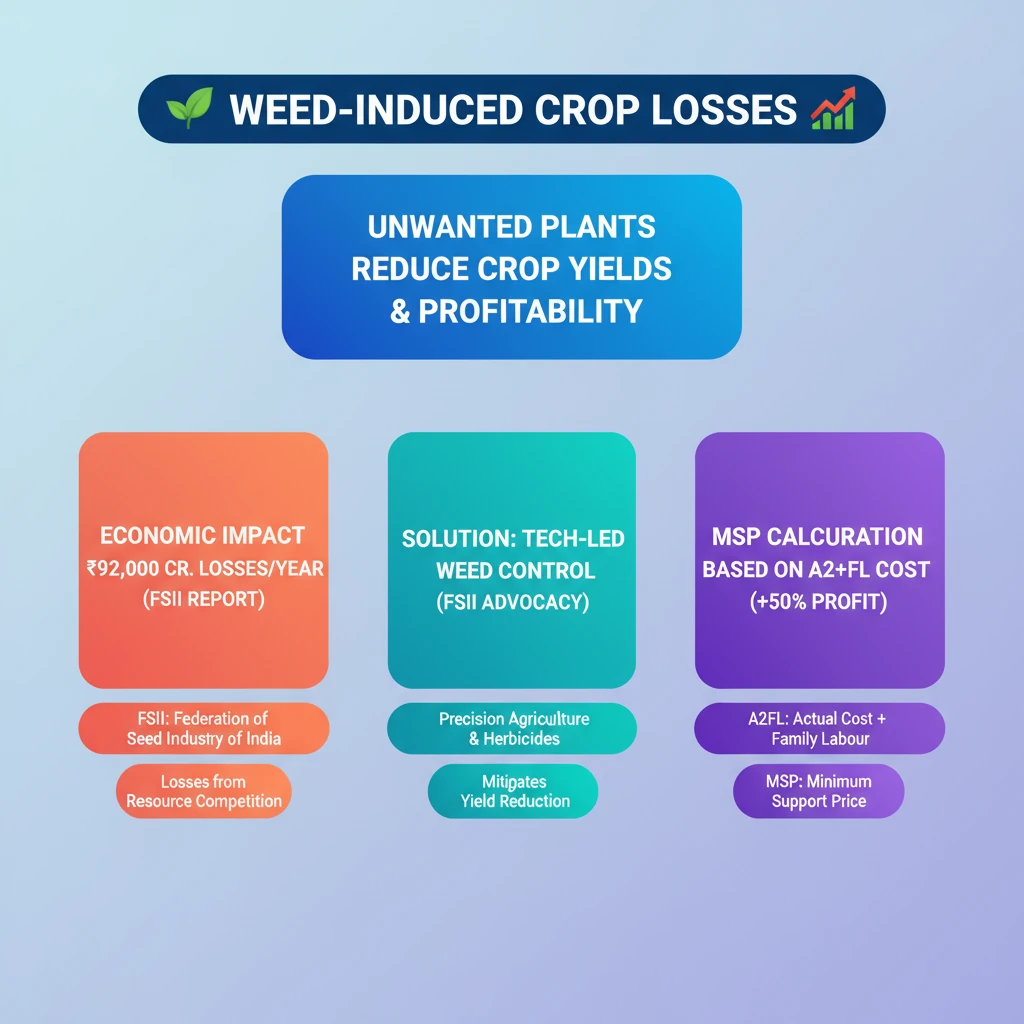
<h4>Understanding Weeds and Their Impact</h4><p><strong>Weeds</strong> are typically unwanted plants that thrive in ecosystems where they disrupt agricultural or ecological balance. They pose a significant threat to crop productivity and overall agricultural sustainability.</p><div class="info-box"><strong>Definition of Weeds:</strong> Unwanted plants that aggressively compete with cultivated crops for essential resources like nutrients, water, and sunlight.</div><p>These plants are characterized by their ability to aggressively compete with cultivated crops and other vegetation. This competition directly impacts the growth and yield of desired crops.</p><ul><li><strong>Aggressive Competition:</strong> Weeds rapidly absorb resources, starving cultivated plants.</li><li><strong>Resilience and Adaptability:</strong> They exhibit significant resilience and adaptability to diverse environmental conditions.</li><li><strong>Rapid Colonization:</strong> Their ability to colonize various habitats quickly makes them a persistent problem.</li></ul><p>Examples of common weeds include <strong>nut grass</strong>, <strong>portulaca</strong>, <strong>common couch</strong>, and <strong>leucaena</strong>, which are prevalent across various agricultural landscapes.</p><h4>Economic Losses Due to Weeds in India</h4><p>Weeds cause substantial economic losses in crop productivity each year, impacting farmer incomes and national food security. These losses highlight a critical area for intervention and technological advancement in agriculture.</p><div class="info-box"><strong>Weed-Induced Crop Losses:</strong> According to a study by the <strong>Federation of Seed Industry of India (FSII)</strong>, weeds cause approximately <strong>Rs 92,000 crore (USD 11 billion)</strong> worth of loss in crop productivity annually in India.</div><p>The <strong>FSII report</strong> emphasizes the urgent need for adopting technology-led weed control strategies. Such strategies are crucial to mitigate this growing problem and protect agricultural output.</p><div class="key-point-box"><strong>Key Recommendation:</strong> The report advocates for the implementation of advanced technology in weed management to reduce pre-harvest losses and enhance crop yields.</div><h4>Federation of Seed Industry of India (FSII)</h4><p>The <strong>Federation of Seed Industry of India (FSII)</strong> is a pivotal organization representing the <strong>R&D-driven plant science industry</strong> in India. It plays a crucial role in supporting the country’s agricultural sector.</p><div class="info-box"><strong>FSII Membership:</strong> A <strong>40-member association</strong> representing companies involved in research and development for plant science.</div><p>FSII is actively involved in the production of high-quality seeds for various agricultural needs, including <strong>food, feed, and fibre crops</strong>. Its efforts contribute significantly to agricultural productivity.</p><p>The federation promotes the adoption of <strong>technology-driven farming solutions</strong> aimed at improving agricultural productivity. This includes strategies to reduce both <strong>pre-harvest and post-harvest losses</strong> in a sustainable manner.</p><ul><li><strong>Global Affiliations:</strong> FSII is affiliated with international bodies such as the <strong>International Seed Federation (ISF)</strong> and the <strong>Asia and Pacific Seed Association (APSA)</strong>.</li><li><strong>Enhanced Collaboration:</strong> These affiliations enhance FSII's global outreach and facilitate collaboration on international best practices in seed technology and agriculture.</li></ul><h4>Agricultural Costing and MSP Calculation</h4><p>Understanding agricultural costing methods is essential for calculating the <strong>Minimum Support Price (MSP)</strong>, which directly impacts farmer remuneration and agricultural policy.</p><div class="info-box"><strong>A2 Cost:</strong> Covers all <strong>paid-out costs</strong> directly incurred by the farmer in cash and kind. This includes expenses on <strong>seeds, fertilisers, pesticides, hired labour, leased-in land, fuel, and irrigation</strong>.</div><p>The <strong>A2+FL cost</strong> expands on A2 by incorporating the estimated value of unpaid family labour. This provides a more comprehensive measure of a farmer's direct expenses and effort.</p><div class="info-box"><strong>A2+FL Cost:</strong> Includes <strong>A2</strong> plus an estimated value of <strong>unpaid family labour</strong>.</div><p>The <strong>C2 cost</strong> is the most comprehensive measure, factoring in additional imputed costs. It reflects the true economic cost of production for farmers.</p><div class="info-box"><strong>C2 Cost:</strong> A comprehensive cost that includes <strong>rentals and interest for owned land</strong> and <strong>fixed capital assets</strong>, in addition to <strong>A2+FL</strong>.</div><p>The government maintains that MSP is fixed at a level of at least <strong>1.5 times the all-India weighted average Cost of Production (CoP)</strong>. However, it calculates this cost as <strong>1.5 times the A2+FL cost</strong>, a point of contention among farmer organizations.</p><div class="exam-tip-box"><strong>UPSC Insight:</strong> The difference between the government's calculation of CoP (1.5x A2+FL) and the demand for 1.5x C2 is a recurring topic in <strong>GS-III Agriculture</strong>. Be prepared to discuss the implications for farmer income and agricultural policy.</div><h4>Key Agricultural Crop Facts: Rice and Wheat</h4><p><strong>Rice</strong> and <strong>Wheat</strong> are India's two most important staple crops, with specific agro-climatic requirements and significant global production shares.</p><div class="exam-tip-box"><strong>Exam Relevance:</strong> Knowing the basic requirements and top producers for major crops like Rice and Wheat is crucial for <strong>Prelims</strong> and for contextualizing answers in <strong>GS-III Agriculture</strong>.</div><table class="info-table"><tr><th>Basis</th><th>Rice</th><th>Wheat</th></tr><tr><td><strong>Temperature</strong></td><td>Between <strong>22-32°C</strong> with high humidity</td><td>Between <strong>10-15°C</strong> (Sowing) and <strong>21-26°C</strong> (Ripening & Harvesting) with bright sunlight</td></tr><tr><td><strong>Rainfall</strong></td><td>Around <strong>150-300 cm</strong></td><td>Around <strong>75-100 cm</strong></td></tr><tr><td><strong>Soil Type</strong></td><td>Deep <strong>clayey</strong> and <strong>loamy</strong> soil</td><td>Well-drained fertile <strong>loamy</strong> and <strong>clayey</strong></td></tr><tr><td><strong>Top Producers (India)</strong></td><td><strong>West Bengal</strong> > <strong>Uttar Pradesh</strong> > <strong>Punjab</strong></td><td><strong>Uttar Pradesh</strong> > <strong>Madhya Pradesh</strong> > <strong>Punjab</strong></td></tr><tr><td><strong>India’s Global Position</strong></td><td><strong>Second largest producer</strong> of rice in the world after China</td><td><strong>Second largest producer</strong> of wheat in the world after China</td></tr></table>
💡 Key Takeaways
- •Weeds are unwanted plants that significantly reduce crop productivity by competing for resources.
- •The Federation of Seed Industry of India (FSII) reports annual crop losses of Rs 92,000 crore due to weeds.
- •FSII advocates for technology-led weed control strategies to mitigate these substantial losses.
- •Agricultural costing methods (A2, A2+FL, C2) are used to calculate Minimum Support Price (MSP).
- •The government calculates MSP based on 1.5 times the A2+FL cost, which is a point of debate.
- •Rice and wheat are India's staple crops, each with distinct temperature, rainfall, and soil requirements.
- •Effective weed management is critical for enhancing crop yields, ensuring food security, and improving farmer livelihoods.
🧠 Memory Techniques

98% Verified Content