Public Trusts in India: Indian Trusts Act, 1882 - Agriculture Allied Sector | UPSC Learning
Topics
0 topics • 0 completed
🔍
No topics match your search

Public Trusts in India: Indian Trusts Act, 1882
Medium⏱️ 10 min read
agriculture allied sector
📖 Introduction
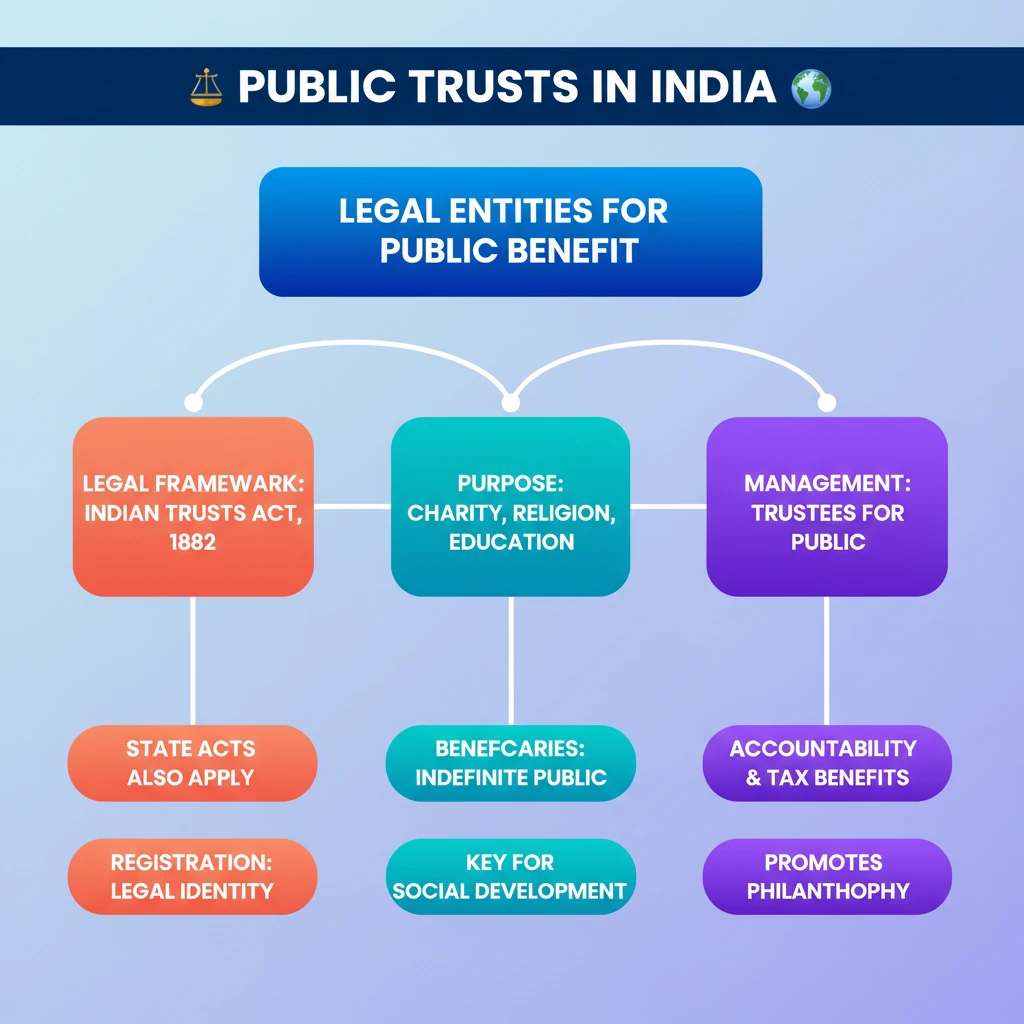
<h4>Understanding Public Trusts</h4><p>A <strong>Public Trust</strong> is a legal entity created for charitable, religious, or educational purposes, benefiting the general public or a significant section of it. Unlike private trusts, their beneficiaries are indeterminate and often large.</p><div class="key-point-box"><strong>Key Concept:</strong> The primary objective of a Public Trust is <strong>philanthropy</strong> and <strong>public welfare</strong>, rather than private gain.</div><h4>Legal Basis: The Indian Trusts Act, 1882</h4><p>In India, <strong>Public Trusts</strong> are primarily governed by the <strong>Indian Trusts Act, 1882</strong>. This central legislation provides the framework for the creation, management, and dissolution of trusts.</p><div class="info-box"><strong>Act Details:</strong> The <strong>Indian Trusts Act, 1882</strong>, defines what a trust is, who can create it, who can be a trustee, and the duties and liabilities of trustees.</div><p>While the <strong>Indian Trusts Act, 1882</strong>, is the central law, specific states also have their own acts for the regulation of public religious and charitable trusts, such as the <strong>Bombay Public Trusts Act, 1950</strong> (now Maharashtra Public Trusts Act).</p><h4>Registration and Its Importance</h4><p>Registration under the <strong>Indian Trusts Act, 1882</strong>, or relevant state acts, provides legal recognition and legitimacy to a Public Trust. This formalizes its existence and operations.</p><ul><li><strong>Legal Identity:</strong> Registration grants the trust a distinct legal identity, enabling it to own property, enter contracts, and sue or be sued.</li><li><strong>Transparency and Accountability:</strong> It mandates certain levels of financial disclosure and regulatory oversight, ensuring accountability to beneficiaries and the public.</li><li><strong>Tax Benefits:</strong> Registered public trusts are often eligible for various tax exemptions under the <strong>Income Tax Act, 1961</strong>, for both the trust and its donors.</li></ul><div class="exam-tip-box"><strong>UPSC Insight:</strong> Differentiate between the central <strong>Indian Trusts Act, 1882</strong> (which primarily covers private trusts but is often referenced for public trusts too, especially where no specific state law exists) and specific state-level Public Trusts Acts. The <strong>Income Tax Act, 1961</strong>, is crucial for understanding their financial implications.</div>
💡 Key Takeaways
- •Public Trusts are legal entities for charitable, religious, or educational purposes benefiting the general public.
- •The Indian Trusts Act, 1882, provides the central legal framework, though state acts also govern public trusts.
- •Registration grants legal identity, ensures accountability, and enables tax benefits.
- •Trustees manage property for the benefit of indefinite beneficiaries (the public).
- •Public Trusts play a crucial role in social development, cultural preservation, and philanthropy.
- •They are eligible for tax exemptions under the Income Tax Act, 1961, which encourages their activities.
- •Regulatory oversight is essential to ensure transparency and prevent misuse of public funds.
🧠 Memory Techniques

98% Verified Content
📚 Reference Sources
•Income Tax Act, 1961 (Sections 12A, 80G)
•Maharashtra Public Trusts Act, 1950 (formerly Bombay Public Trusts Act)
•Andhra Pradesh Charitable and Hindu Religious Institutions and Endowments Act, 1987
•Ministry of Corporate Affairs, Government of India publications on NGOs/Trusts
•Legal databases and academic articles on Indian Trust Law