What is the Nitrogen Cycle? - Agriculture Allied Sector | UPSC Learning
Topics
0 topics • 0 completed
🔍
No topics match your search
What is the Nitrogen Cycle?
Medium⏱️ 6 min read
agriculture allied sector
📖 Introduction
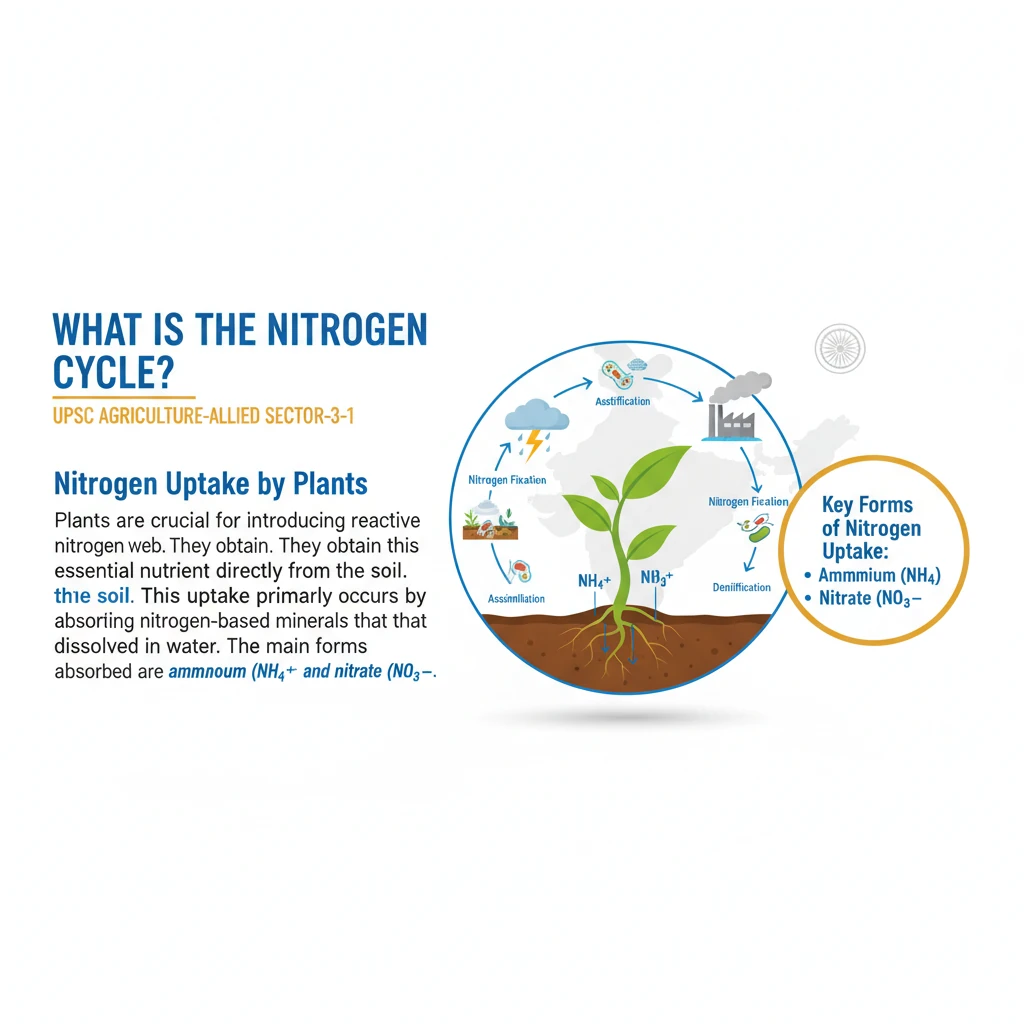
<h4>Nitrogen Uptake by Plants</h4><p>Plants are crucial for introducing <strong>reactive nitrogen</strong> into the food web. They obtain this essential nutrient directly from the soil.</p><p>This uptake primarily occurs by absorbing <strong>nitrogen-based minerals</strong> that are dissolved in water. The main forms absorbed are <strong>ammonium (NH4+)</strong> and <strong>nitrate (NO3–)</strong>.</p><div class="info-box"><strong>Key Forms of Nitrogen Uptake:</strong><ul><li><strong>Ammonium (NH4+):</strong> A positively charged ion, directly usable by plants.</li><li><strong>Nitrate (NO3–):</strong> A negatively charged ion, also readily absorbed by plant roots.</li></ul></div><h4>Biological Importance of Nitrogen for Life</h4><p>Nitrogen is a fundamental element for all life forms, playing a critical role in the structure and function of biological molecules.</p><p>For humans and animals, the reliance on plants is significant. We obtain nine <strong>essential nitrogen-rich amino acids</strong> by consuming plants or animals that have consumed plants.</p><div class="key-point-box"><strong>Nitrogen's Role in the Human Body:</strong><ul><li>Forms the backbone of <strong>proteins</strong> and <strong>nucleic acids (DNA, RNA)</strong>.</li><li>Constitutes approximately <strong>2.6% of the human body's total mass</strong>.</li><li>Essential for enzymes, hormones, and neurotransmitters.</li></ul></div><div class="exam-tip-box">Understanding nitrogen uptake and its biological role is vital for <strong>UPSC Prelims (General Science, Environment)</strong> and <strong>Mains GS-III (Agriculture, Environment)</strong>. Focus on the forms of nitrogen and its significance in food chains.</div>
💡 Key Takeaways
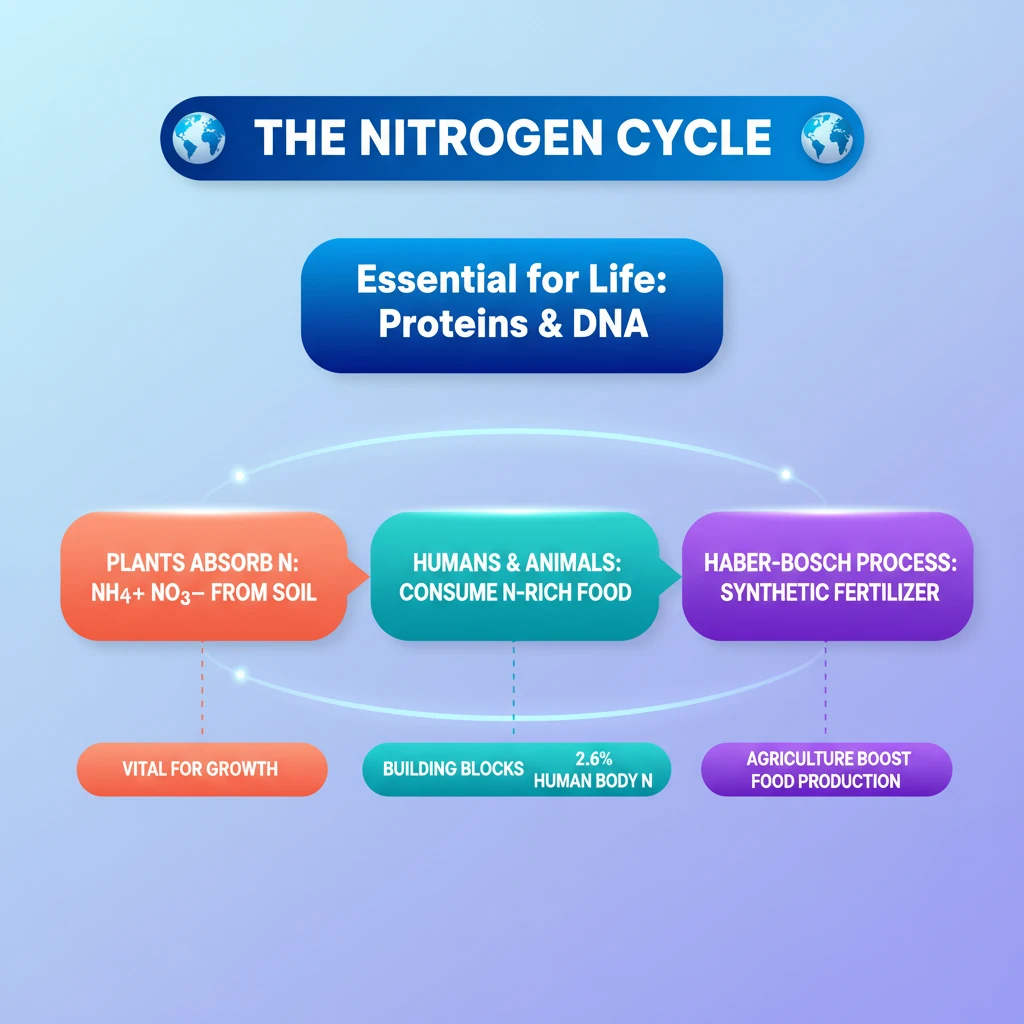
- •Plants absorb reactive nitrogen as ammonium (NH4+) and nitrate (NO3–) from the soil.
- •Humans and animals obtain essential nitrogen-rich amino acids by consuming plants or plant-eating animals.
- •Nitrogen is vital for forming proteins and nucleic acids in all living organisms.
- •Approximately 2.6% of the human body is composed of nitrogen.
- •The Haber-Bosch process revolutionized agriculture by enabling synthetic nitrogen fertilizer production.
- •Excessive nitrogen use leads to environmental issues like eutrophication and nitrous oxide emissions.
🧠 Memory Techniques

98% Verified Content
📚 Reference Sources
•NCERT Class 11 Biology: Mineral Nutrition
•NCERT Class 12 Chemistry: Environmental Chemistry
•Environmental Science: Earth as a Living Planet by Botkin & Keller
•FAO (Food and Agriculture Organization) publications on sustainable agriculture