CSR for Agriculture Sustainability - Agriculture Allied Sector | UPSC Learning
Topics
0 topics • 0 completed
🔍
No topics match your search

CSR for Agriculture Sustainability
Medium⏱️ 6 min read
agriculture allied sector
📖 Introduction
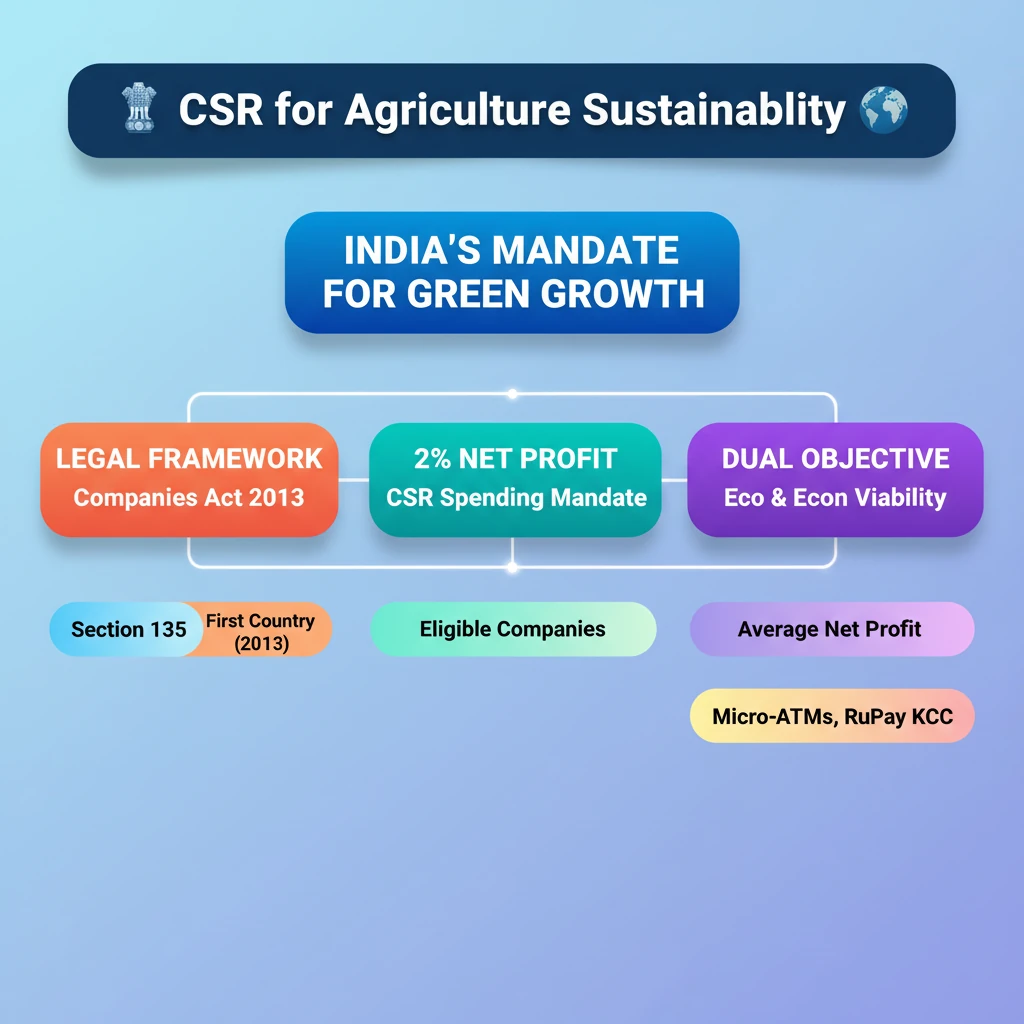
<h4>Introduction to CSR for Agriculture Sustainability</h4><p>With increasing contributions, the focus is on how <strong>Corporate Social Responsibility (CSR)</strong> can effectively support <strong>Indian agriculture</strong>.</p><p>The primary aim is to ensure agriculture becomes both <strong>economically viable</strong> and <strong>ecologically sustainable</strong>.</p><div class="key-point-box"><strong>Key Focus:</strong> Leveraging <strong>CSR</strong> for comprehensive development in the agricultural sector, encompassing sustainability and financial empowerment.</div><h4>Financial Inclusion through CSR Principles</h4><p><strong>Cooperative societies</strong> are being equipped with modern financial tools to enhance farmer access to credit.</p><p>This includes the provision of <strong>RuPay Kisan Credit Cards</strong> and <strong>Micro-ATMs</strong>.</p><div class="info-box">These tools facilitate access to <strong>low-cost loans</strong>, thereby promoting greater <strong>financial inclusion</strong> and support for farmers.</div><h4>Understanding Corporate Social Responsibility (CSR) in India</h4><div class="info-box"><strong>What is CSR?</strong> <strong>CSR</strong> is a business practice where companies voluntarily integrate <strong>social, environmental, and ethical concerns</strong> into their core operations and interactions with stakeholders.</div><p>These concerns often encompass areas like <strong>environmental sustainability</strong>, <strong>poverty reduction</strong>, <strong>education</strong>, and <strong>healthcare</strong>.</p><h4>India's Pioneering CSR Mandate</h4><p><strong>India</strong> holds the distinction of being the <strong>first country</strong> globally to legally mandate <strong>CSR</strong>.</p><p>This landmark legislation was introduced in <strong>2013</strong> under <strong>Section 135</strong> of the <strong>Companies Act, 2013</strong>.</p><div class="info-box"><strong>CSR Fund Disbursement (2014-2023):</strong> A total of <strong>Rs 1.84 lakh crore</strong> of <strong>CSR funds</strong> were disbursed during this period.</div><h4>Legislative Framework and Mandatory Requirements</h4><p>The <strong>CSR concept</strong> in India is governed by a robust legislative framework, ensuring its structured implementation:</p><ul><li><strong>Section 135</strong> of the <strong>Companies Act, 2013</strong></li><li><strong>Schedule VII</strong> of the <strong>Companies Act, 2013</strong></li><li><strong>Companies (CSR Policy) Rules, 2014</strong></li></ul><p><strong>CSR</strong> became a <strong>mandatory requirement</strong> for specific companies, effective from <strong>1st April 2014</strong>.</p><h4>CSR Criteria and Spending Mandate</h4><div class="info-box"><strong>CSR Criteria:</strong> Provisions apply to companies meeting any of the following criteria in the preceding financial year:<ul><li>A <strong>net worth</strong> of over <strong>Rs 5 billion</strong></li><li>A <strong>turnover</strong> exceeding <strong>Rs 10 billion</strong></li><li>A <strong>net profit</strong> greater than <strong>Rs 50 million</strong></li></ul>Such companies are mandated to spend a minimum of <strong>2% of their average net profit</strong> over the last three financial years on <strong>CSR activities</strong>.</div><h4>CSR Priorities and Agricultural Initiatives</h4><div class="exam-tip-box">While <strong>healthcare, water, sanitation, and hygiene</strong> remain the top priorities for companies, <strong>environment and sustainability</strong> is the <strong>second priority</strong> for <strong>CSR contributions</strong>. This underscores its significant potential for the agricultural sector.</div><p>Examples of <strong>CSR-supported initiatives</strong> directly benefiting agriculture include:</p><ul><li>Establishment of <strong>grain banks</strong> for improved food storage and security.</li><li>Development of <strong>farmer schools</strong> for skill enhancement and knowledge dissemination.</li><li>Implementation of <strong>water conservation</strong> projects to ensure efficient resource management.</li><li>Promotion of <strong>energy-efficient irrigation</strong> systems to reduce operational costs and environmental impact.</li></ul>
💡 Key Takeaways
- •India was the first country to legally mandate CSR in 2013.
- •CSR in India is governed by Section 135 of the Companies Act, 2013.
- •Eligible companies must spend 2% of their average net profit on CSR activities.
- •CSR aims to make agriculture economically viable and ecologically sustainable.
- •Financial inclusion, through tools like Micro-ATMs and RuPay Kisan Credit Cards, is a key CSR focus.
- •Environment and sustainability is the second highest priority for CSR spending.
- •CSR supports initiatives like grain banks, farmer schools, and water conservation.
🧠 Memory Techniques

98% Verified Content