Protection of Plant Varieties and Farmers’ Rights Act, 2001 - Agriculture Allied Sector | UPSC Learning
Topics
0 topics • 0 completed
🔍
No topics match your search
Protection of Plant Varieties and Farmers’ Rights Act, 2001
Medium⏱️ 7 min read
agriculture allied sector
📖 Introduction
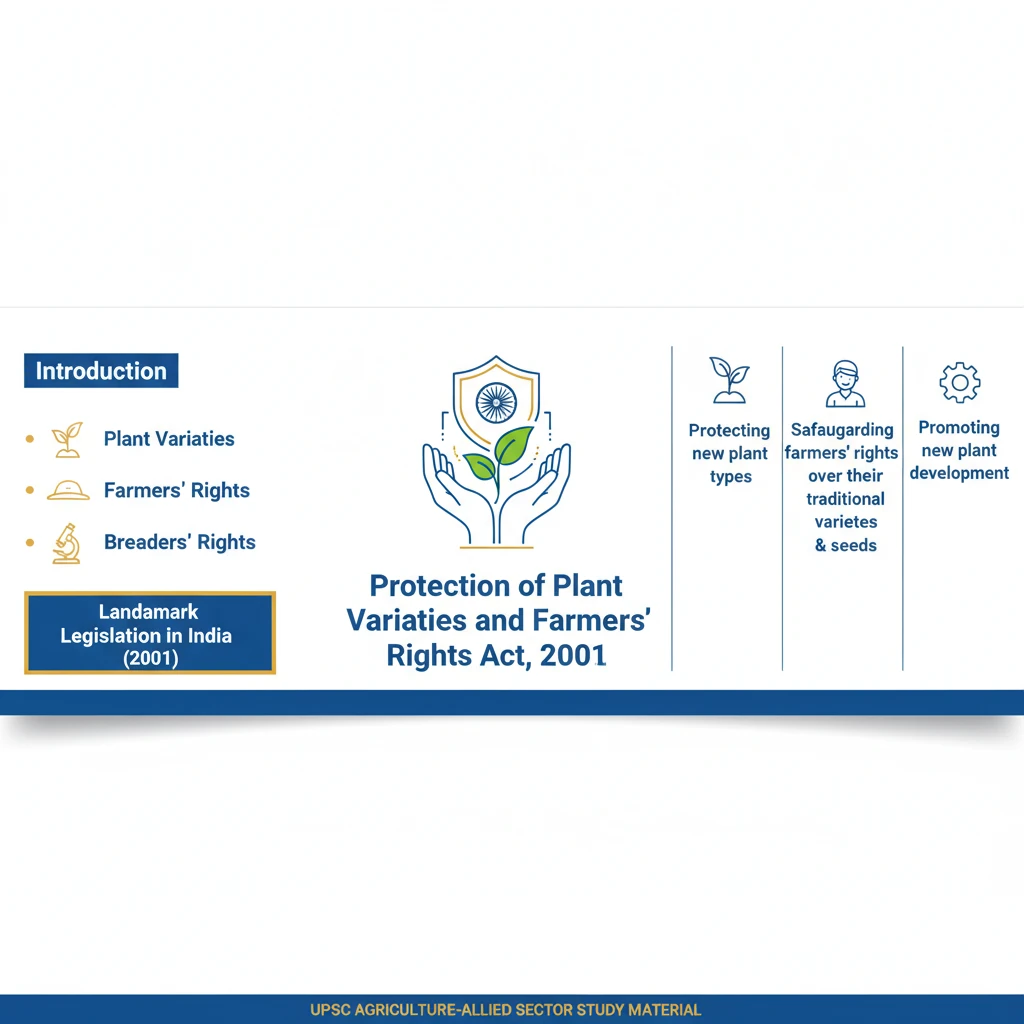
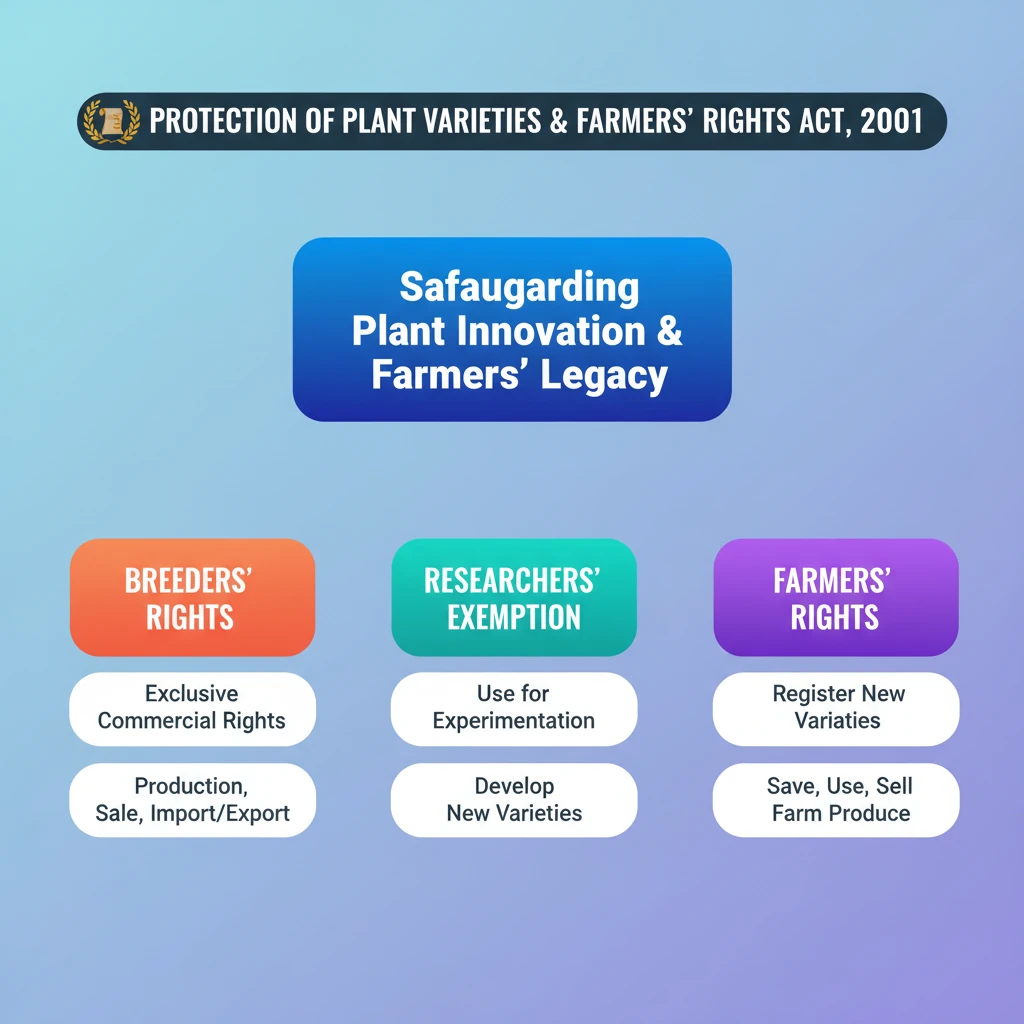
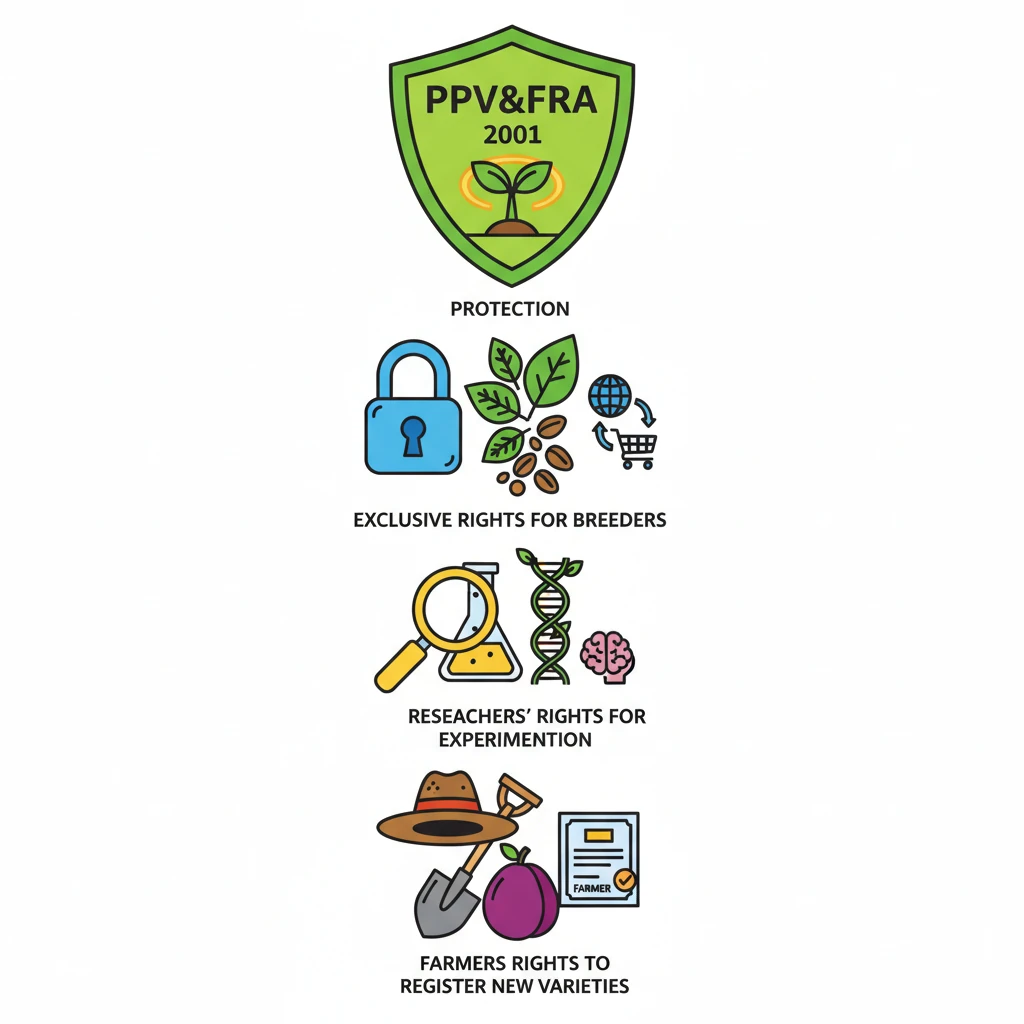
<h4>Introduction to the Protection of Plant Varieties and Farmers’ Rights Act, 2001</h4><p>The <strong>Protection of Plant Varieties and Farmers’ Rights Act (PPV&FRA), 2001</strong>, is a landmark legislation in India. It aims to establish an effective system for the protection of <strong>plant varieties</strong>, the rights of <strong>farmers</strong> and <strong>plant breeders</strong>, and to encourage the development of new varieties of plants.</p><div class="key-point-box">This Act is crucial for balancing intellectual property rights in agriculture with the traditional rights of farmers. It aligns with India's commitments under the <strong>TRIPS Agreement</strong> and the <strong>International Treaty on Plant Genetic Resources for Food and Agriculture (ITPGRFA)</strong>.</div><h4>Breeders' Rights under PPV&FRA</h4><p>The Act grants specific <strong>exclusive rights</strong> to breeders whose new plant varieties are registered. These rights are designed to incentivize innovation and investment in plant breeding.</p><ul><li><strong>Production:</strong> Breeders have the sole right to produce the propagating material of their protected variety.</li><li><strong>Sale and Marketing:</strong> They control the sale and marketing of the protected variety.</li><li><strong>Distribution:</strong> The distribution of the variety falls under their exclusive purview.</li><li><strong>Import and Export:</strong> Breeders hold the exclusive right to import and export their registered plant varieties.</li></ul><div class="info-box"><strong>Objective:</strong> To provide a robust legal framework that encourages private sector investment in agricultural research and development, similar to patent protection in other industries.</div><h4>Researchers' Rights under PPV&FRA</h4><p>To foster further scientific advancement, the Act includes provisions for <strong>researchers' rights</strong>. This ensures that registered varieties can be utilized for academic and developmental purposes without undue restrictions.</p><ul><li><strong>Experimentation:</strong> Researchers are permitted to use registered varieties for experimentation.</li><li><strong>Research Purposes:</strong> The Act allows the use of protected varieties for conducting further research, including developing new varieties.</li></ul><div class="key-point-box">This provision prevents monopolies from hindering scientific progress, striking a balance between protecting breeders' rights and promoting public good through research.</div><h4>Farmers' Rights under PPV&FRA</h4><p>The <strong>PPV&FRA, 2001</strong>, uniquely recognizes and protects the traditional rights and contributions of farmers. This is a distinguishing feature compared to many international intellectual property regimes.</p><h5>Registration and Protection for Farmers</h5><p>Farmers who have played a role in evolving or developing new plant varieties are entitled to similar recognition as traditional breeders. They can apply for <strong>registration and protection</strong> of their unique varieties.</p><div class="info-box"><strong>Example:</strong> A farmer developing a drought-resistant local landrace through generations of selection can get it registered under the Act.</div><h5>Traditional Practices and Use of Produce</h5><p>The Act safeguards the traditional practices of farmers regarding their farm produce. This is a critical aspect for ensuring food security and preserving agricultural diversity.</p><ul><li><strong>Save:</strong> Farmers can save seeds from their harvest.</li><li><strong>Use:</strong> They can use these saved seeds for subsequent plantings.</li><li><strong>Exchange:</strong> Farmers are allowed to exchange seeds with other farmers.</li><li><strong>Share:</strong> They can share their farm produce, including protected varieties.</li><li><strong>Sell:</strong> Farmers can sell their farm produce, including seeds of protected varieties, subject to certain conditions (e.g., not as branded seed).</li></ul><h5>Recognition and Rewards for Conservation</h5><p>The Act acknowledges the invaluable role farmers play in preserving genetic diversity. It provides for <strong>recognition and rewards</strong> for their efforts in conserving plant genetic resources.</p><div class="exam-tip-box">UPSC often asks about the unique provisions for farmers' rights. Highlighting compensation, fee exemptions, and the right to save/sell produce is essential for answers in <strong>GS-III Agriculture</strong>.</div><h5>Compensation for Non-Performance</h5><p>To protect farmers from potential losses, the Act includes provisions for <strong>compensation</strong>. If a protected variety fails to perform as claimed by the breeder, farmers can seek redressal.</p><div class="info-box"><strong>Condition:</strong> If the seed of a protected variety does not conform to the claimed characteristics of the variety, the farmer is entitled to compensation.</div><h5>Exemption from Fees</h5><p>Recognizing the economic realities of farmers, the Act provides significant financial relief in legal proceedings. Farmers are <strong>exempt from paying fees</strong> in any proceedings under the Act.</p><ul><li>This applies to proceedings before relevant authorities (e.g., the <strong>PPV&FRA Authority</strong>).</li><li>It also extends to proceedings before courts, ensuring access to justice.</li></ul>
💡 Key Takeaways
- •The PPV&FRA, 2001, protects new plant varieties and the rights of breeders and farmers.
- •Breeders get exclusive rights for production, sale, marketing, distribution, import, and export of protected varieties.
- •Researchers can use registered varieties for experimentation and developing new varieties.
- •Farmers who develop new varieties can register them, similar to breeders.
- •Farmers retain the right to save, use, exchange, share, or sell their farm produce, including protected varieties, with conditions.
- •The Act provides compensation to farmers if protected varieties fail to perform as claimed.
- •Farmers are exempt from paying fees in legal proceedings under the Act.
🧠 Memory Techniques
98% Verified Content
📚 Reference Sources
•Protection of Plant Varieties and Farmers' Rights Authority (PPV&FRA) website
•Drishti IAS notes on Agriculture Allied Sector