What is the DirectSeeded Rice (DSR) Technique? - Agriculture Allied Sector | UPSC Learning
Topics
0 topics • 0 completed
🔍
No topics match your search
What is the DirectSeeded Rice (DSR) Technique?
Easy⏱️ 4 min read
agriculture allied sector
📖 Introduction
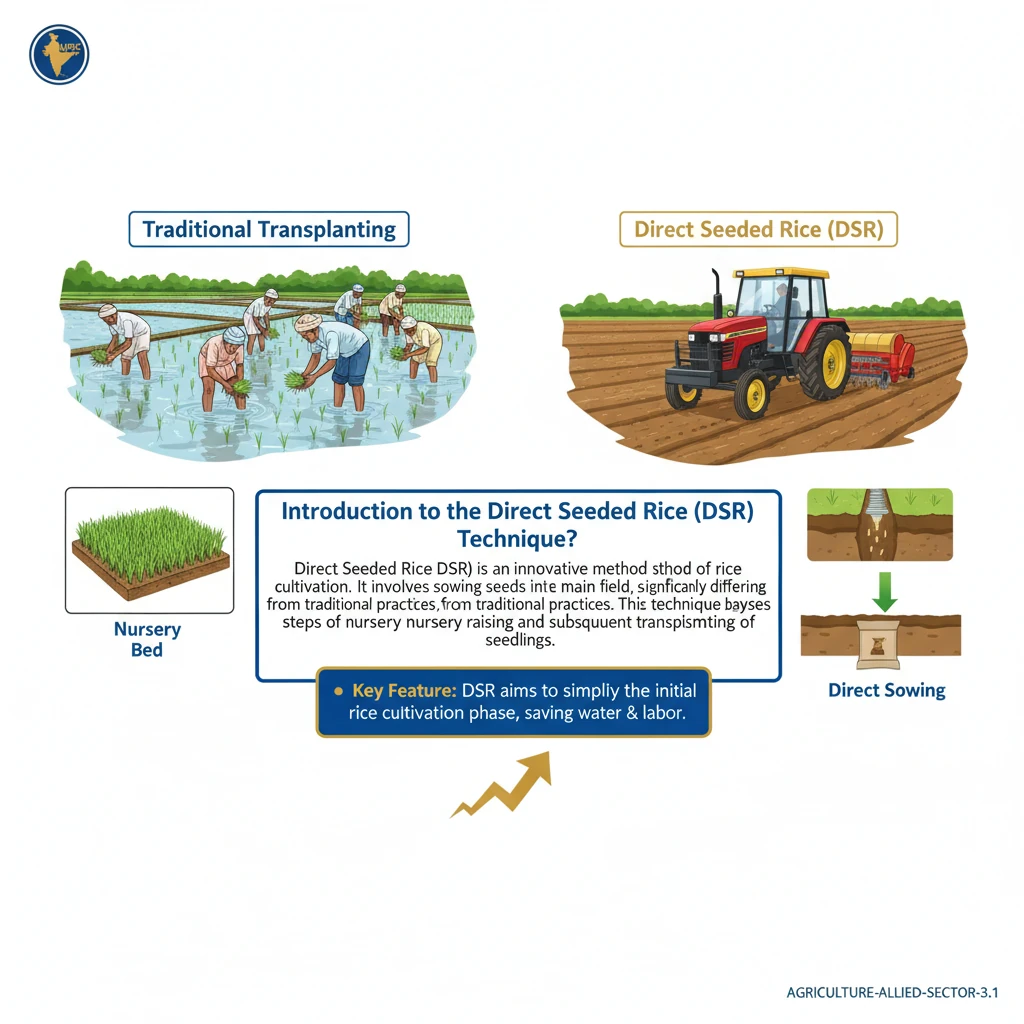
<h4>Introduction to Direct Seeded Rice (DSR)</h4><p><strong>Direct Seeded Rice (DSR)</strong> is an innovative method of <strong>rice cultivation</strong>. It involves sowing seeds directly into the main field, significantly differing from traditional practices.</p><p>This technique bypasses the conventional steps of <strong>nursery raising</strong> and subsequent <strong>transplanting</strong> of seedlings.</p><div class="info-box"><strong>Key Feature:</strong> DSR aims to simplify the initial stages of rice cultivation by direct sowing, reducing dependency on labour and water.</div><h4>Advantages of DSR Technique</h4><p>The adoption of <strong>DSR</strong> offers several significant benefits for farmers and the environment, aligning with sustainable agriculture goals.</p><ul><li><strong>Labour and Cost Savings:</strong> DSR eliminates the need for manual labour-intensive tasks like nursery preparation and transplanting, which significantly reduces overall cultivation costs.</li><li><strong>Water Conservation:</strong> This method requires less water compared to the traditional flooded rice cultivation, making it crucial in areas facing water scarcity and depleting groundwater.</li><li><strong>Early Crop Maturity:</strong> DSR crops often mature earlier than transplanted rice, allowing for more efficient land use and potentially enabling farmers to undertake multiple cropping cycles.</li></ul><div class="key-point-box"><strong>UPSC Relevance:</strong> These advantages directly address national priorities such as increasing <strong>farmer income</strong>, promoting <strong>water security</strong>, and fostering <strong>sustainable agricultural practices</strong>.</div><h4>Methods of Direct Seeded Rice</h4><p>Various approaches can be employed for <strong>DSR</strong>, each suited to different agro-climatic conditions and farmer preferences.</p><p>One prominent method explicitly mentioned is <strong>Wet Seeding</strong>.</p><div class="info-box"><strong>Wet Seeding:</strong> This technique involves sowing pre-germinated rice seeds directly into a puddled and leveled field. The soil is typically saturated or has a thin film of standing water.</div><div class="exam-tip-box">While the source highlights <strong>Wet Seeding</strong>, it's important to note that <strong>Dry Seeding</strong> (sowing dry seeds in dry or moist soil) is another common DSR method. For exam questions, focus on the method specifically asked or mentioned in the context.</div>
💡 Key Takeaways
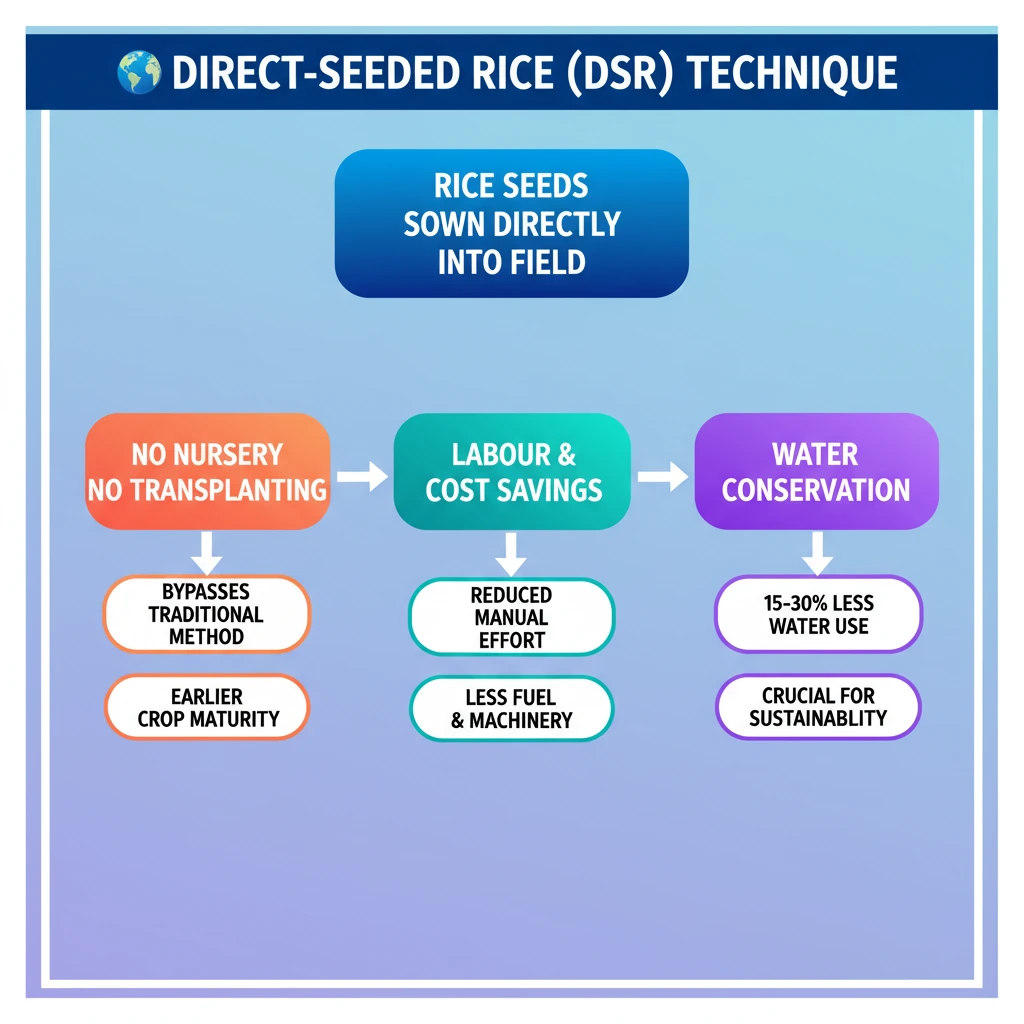
- •Direct Seeded Rice (DSR) is a method where rice seeds are sown directly into the main field.
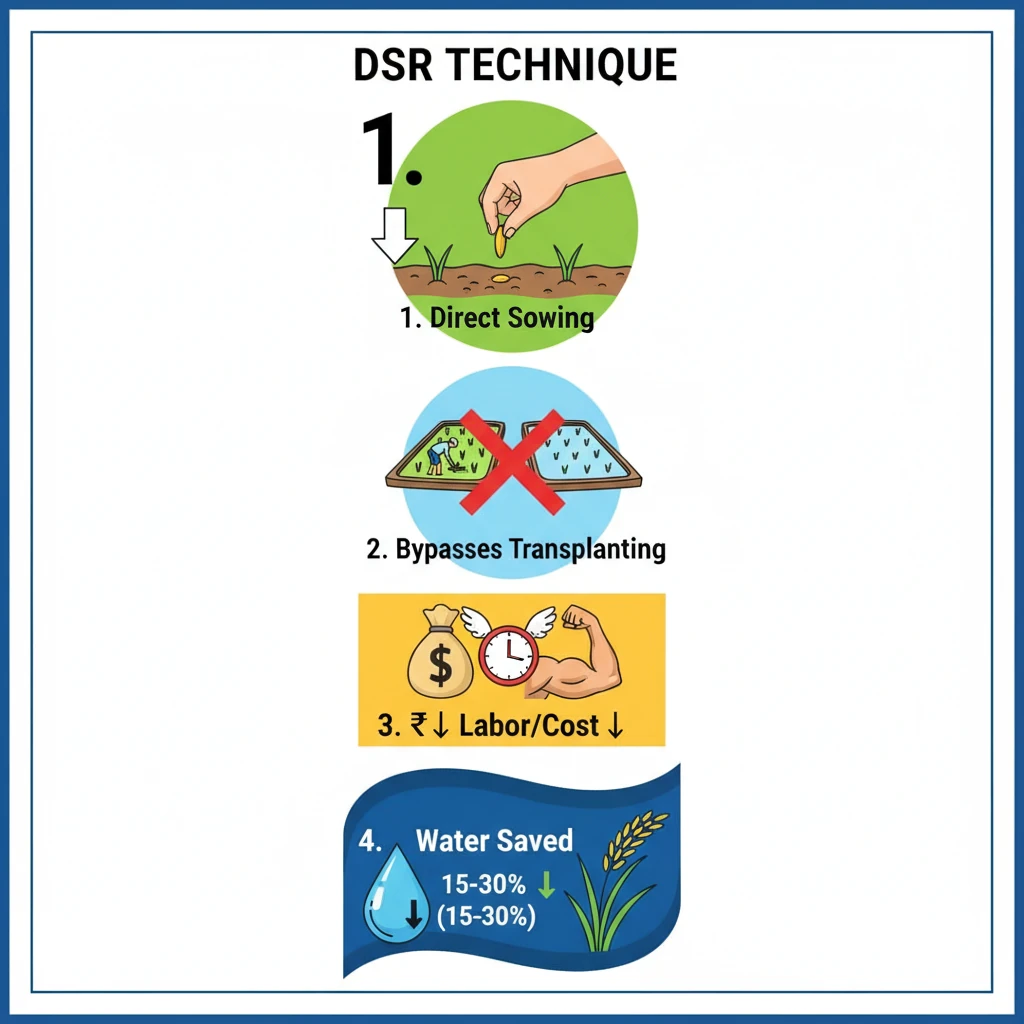
- •It bypasses the traditional nursery raising and transplanting process.
- •Key advantages include significant labour and cost savings for farmers.
- •DSR is crucial for water conservation in rice cultivation, reducing consumption by 15-30%.
- •It generally leads to earlier crop maturity, allowing for increased cropping intensity.
- •Wet seeding is a common method of DSR, involving pre-germinated seeds in puddled fields.
- •DSR is a vital practice for promoting sustainable agriculture and enhancing farmer welfare in India.
🧠 Memory Techniques
95% Verified Content