Agro-Economy: MSP, Subsidies, Agri-Marketing - Agriculture Allied Sector | UPSC Learning
Topics
0 topics • 0 completed
🔍
No topics match your search

Agro-Economy: MSP, Subsidies, Agri-Marketing
Medium⏱️ 10 min read
agriculture allied sector
📖 Introduction
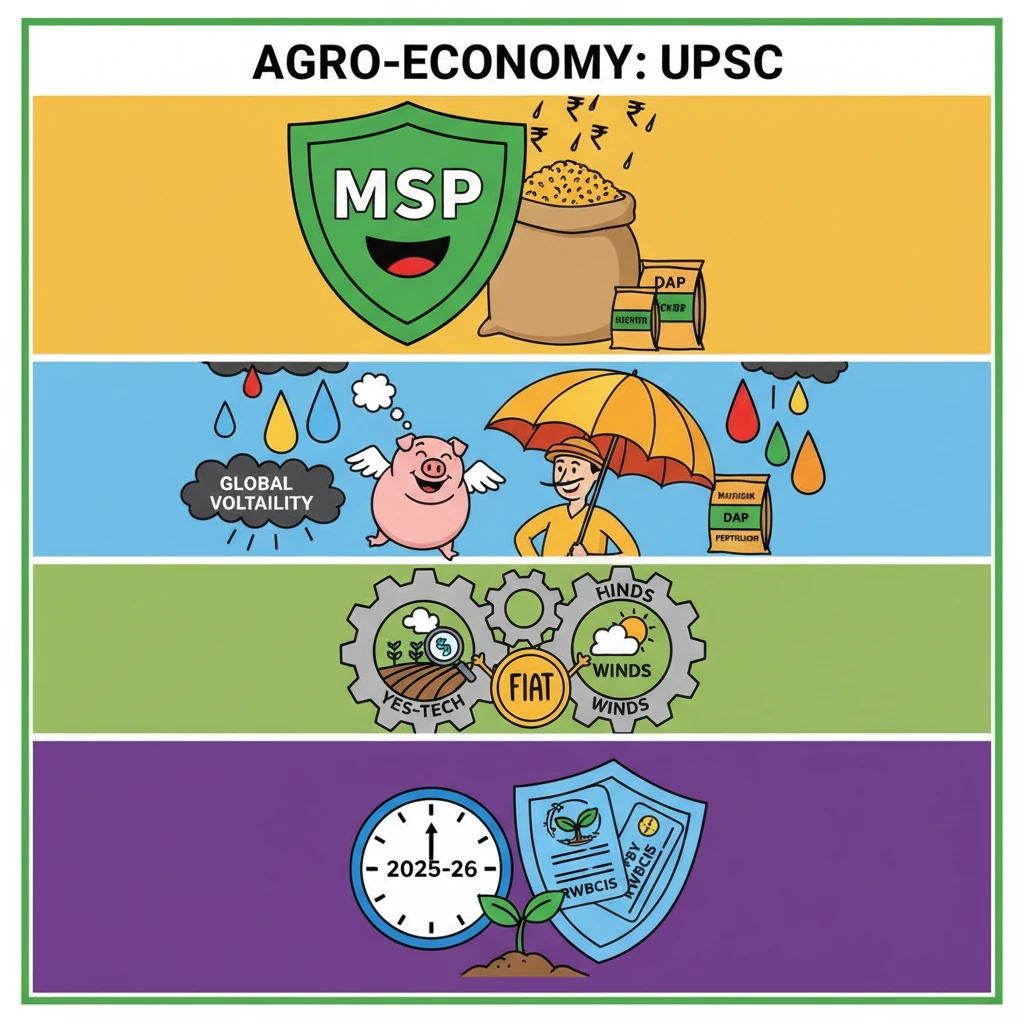
<h4>Recent Government Measures for Farmers</h4><p>The <strong>Union Cabinet</strong> has recently approved significant measures to bolster support for <strong>Indian farmers</strong>. These initiatives aim to provide financial stability and technological advancements in the agricultural sector.</p><p>Key among these are the extension of a special subsidy for <strong>Diammonium Phosphate (DAP) fertilizers</strong> and the continuation of crucial <strong>crop insurance schemes</strong> until <strong>2025-26</strong>.</p><h4>Continuation of Crop Insurance Schemes</h4><p>The <strong>Union Cabinet</strong> has given its approval for the continuation of two major crop insurance schemes:</p><ul><li><strong>Pradhan Mantri Fasal Bima Yojana (PMFBY)</strong></li><li><strong>Restructured Weather Based Crop Insurance Scheme (RWBCIS)</strong></li></ul><p>Both schemes will continue to operate until the financial year <strong>2025-26</strong>, ensuring ongoing protection for farmers against crop losses.</p><h4>DAP Fertilizer Subsidy Extension</h4><p>A significant measure includes extending the <strong>one-time special package</strong> on <strong>DAP</strong>. This extension goes beyond the existing <strong>Nutrient Based Subsidy</strong>, effective from <strong>January 1, 2025</strong>, until further orders.</p><div class="key-point-box">This extension is critical for ensuring that <strong>DAP fertilizers</strong> remain affordable for farmers during both the <strong>Kharif</strong> and <strong>Rabi 2024-25</strong> seasons, mitigating the impact of global market volatility.</div><h4>Fund for Innovation and Technology (FIAT)</h4><p>The government has also approved the creation of the <strong>Fund for Innovation and Technology (FIAT)</strong>. This fund has a substantial corpus of <strong>Rs 824.77 crore</strong>.</p><p><strong>FIAT</strong> is designed to finance technological initiatives under specific schemes, namely <strong>YES-TECH</strong> and <strong>WINDS</strong>. The overarching goal is to enhance transparency and improve the accuracy and speed of claim calculation and settlement processes.</p><h4>Yield Estimation System using Technology (YES-TECH)</h4><p><strong>YES-TECH</strong> is a technological initiative under <strong>FIAT</strong> that leverages <strong>remote sensing technology</strong> for precise yield estimation. This system ensures greater accuracy in assessing crop output.</p><div class="info-box"><strong>Key Feature:</strong> <strong>YES-TECH</strong> mandates a minimum of <strong>30% weightage</strong> to technology-based yield estimates, integrating modern methods into traditional assessment.</div><h4>Weather Information and Network Data Systems (WINDS)</h4><p>Another crucial initiative supported by <strong>FIAT</strong> is <strong>WINDS</strong>. This system aims to significantly enhance weather data collection and dissemination across rural areas.</p><ul><li><strong>Automatic Weather Stations:</strong> To be installed at the <strong>block level</strong>.</li><li><strong>Rain Gauges:</strong> To be installed at the <strong>panchayat level</strong>.</li></ul><div class="key-point-box">The objective of <strong>WINDS</strong> is to increase network density fivefold, providing hyper-local weather data crucial for agricultural planning and risk management.</div><h4>Pradhan Mantri Fasal Bima Yojana (PMFBY) Explained</h4><p>The <strong>Pradhan Mantri Fasal Bima Yojana (PMFBY)</strong> is a flagship <strong>crop insurance scheme</strong> designed to safeguard farmers from financial losses.</p><p>It provides comprehensive protection against unforeseen crop failures caused by various factors like rainfall, temperature fluctuations, frost, and humidity.</p><div class="info-box"><strong>Aim:</strong> A <strong>central sector scheme</strong> offering comprehensive crop insurance from the <strong>pre-sowing to post-harvest period</strong>.</div><h4>PMFBY Coverage and Eligibility</h4><p><strong>PMFBY</strong> extends its coverage to a wide range of agricultural produce:</p><ul><li><strong>Food Crops:</strong> Cereals, millets, and pulses.</li><li><strong>Oilseeds</strong></li><li><strong>Annual Commercial/Annual Horticultural Crops</strong></li></ul><p>All farmers, including <strong>sharecroppers</strong> and <strong>tenant farmers</strong>, are eligible for coverage, provided they are cultivating notified crops in designated notified areas.</p><h4>PMFBY Premium Structure</h4><p>The scheme features a farmer-friendly premium structure, with the remaining premium being subsidized by the government:</p><ul><li><strong>Kharif Crops:</strong> Farmers pay a premium of <strong>2%</strong>.</li><li><strong>Rabi Crops:</strong> Farmers pay a premium of <strong>1.5%</strong>.</li><li><strong>Commercial/Horticulture Crops:</strong> Farmers pay a premium of <strong>5%</strong>.</li></ul><h4>Minimum Support Price (MSP) and its Legalization Debate</h4><p>The <strong>Cabinet Committee on Economic Affairs (CCEA)</strong> recently increased the <strong>Minimum Support Price (MSP)</strong> for six <strong>Rabi crops</strong>. These crops include <strong>wheat, barley, gram, lentil, rapeseed, mustard, and safflower</strong>.</p><p>This increase has reignited the long-standing debate among farmers regarding the demand for the <strong>legalization of MSP</strong> and its potential implications for the broader agricultural ecosystem in India.</p><h4>Cabinet Committee on Economic Affairs (CCEA)</h4><p>The <strong>CCEA</strong> is a high-level government body that plays a crucial role in India's economic policy formulation.</p><div class="info-box"><strong>Chaired by:</strong> The <strong>Prime Minister</strong>.<br><strong>Primary Role:</strong> Sets priorities for public sector investments and continuously reviews economic trends.</div><p>The committee develops an integrated economic policy framework and oversees policies and activities in the economic field, particularly those requiring high-level decisions, including foreign investment.</p><h4>What is Minimum Support Price (MSP)?</h4><p>The <strong>MSP regime</strong> was initially established in <strong>1965</strong> as a critical market intervention mechanism by the Indian government.</p><p>Its primary objectives are to enhance <strong>national food security</strong> and to protect farmers from significant declines in market prices for their produce.</p><div class="info-box"><strong>Origin:</strong> Established in <strong>1965</strong> with the setting up of the <strong>Agricultural Prices Commission (APC)</strong>, later renamed the <strong>Commission for Agricultural Costs and Prices (CACP)</strong>.</div><h4>MSP Calculation Methodology</h4><p>The <strong>Commission for Agricultural Costs and Prices (CACP)</strong> is responsible for calculating the <strong>MSP</strong> for various crops.</p><p>The <strong>CACP</strong> determines three distinct categories of production costs for each crop. These calculations are performed both at the individual <strong>state level</strong> and as <strong>all-India averages</strong> to ensure comprehensive and equitable pricing recommendations.</p>

💡 Key Takeaways
- •Government measures aim to support Indian farmers through financial and technological interventions.
- •PMFBY and RWBCIS crop insurance schemes are extended until 2025-26 to protect farmers.
- •DAP fertilizer subsidy ensures affordability for farmers despite global market volatility.
- •FIAT funds YES-TECH and WINDS for transparent yield estimation and hyper-local weather data.
- •MSP, established in 1965 by APC (now CACP), guarantees minimum prices to protect farmers.
- •The demand for MSP legalization remains a significant debate in agricultural policy.
- •CCEA, chaired by the PM, is crucial for economic policy and investment decisions.
🧠 Memory Techniques
98% Verified Content