Agriculture Development in India - Agriculture Allied Sector | UPSC Learning
Topics
0 topics • 0 completed
🔍
No topics match your search
Agriculture Development in India
Medium⏱️ 8 min read
agriculture allied sector
📖 Introduction
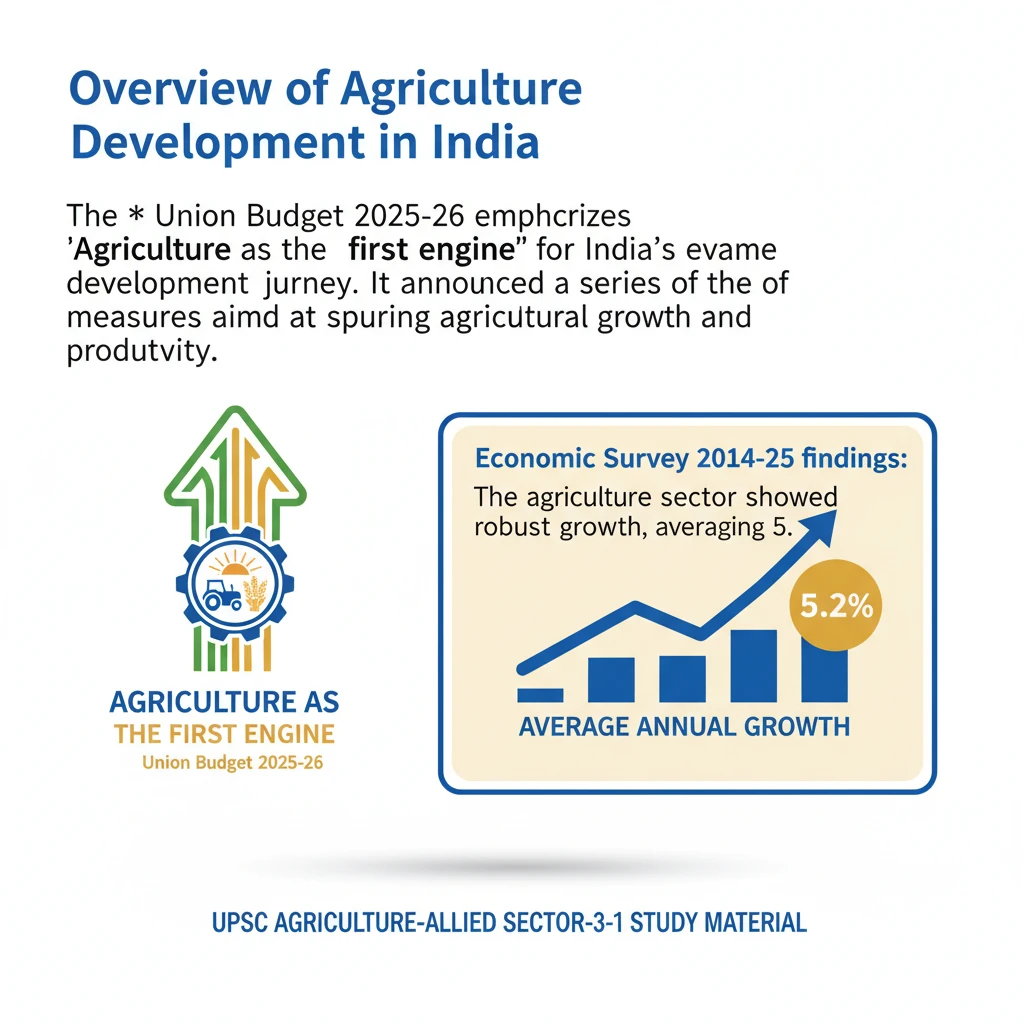
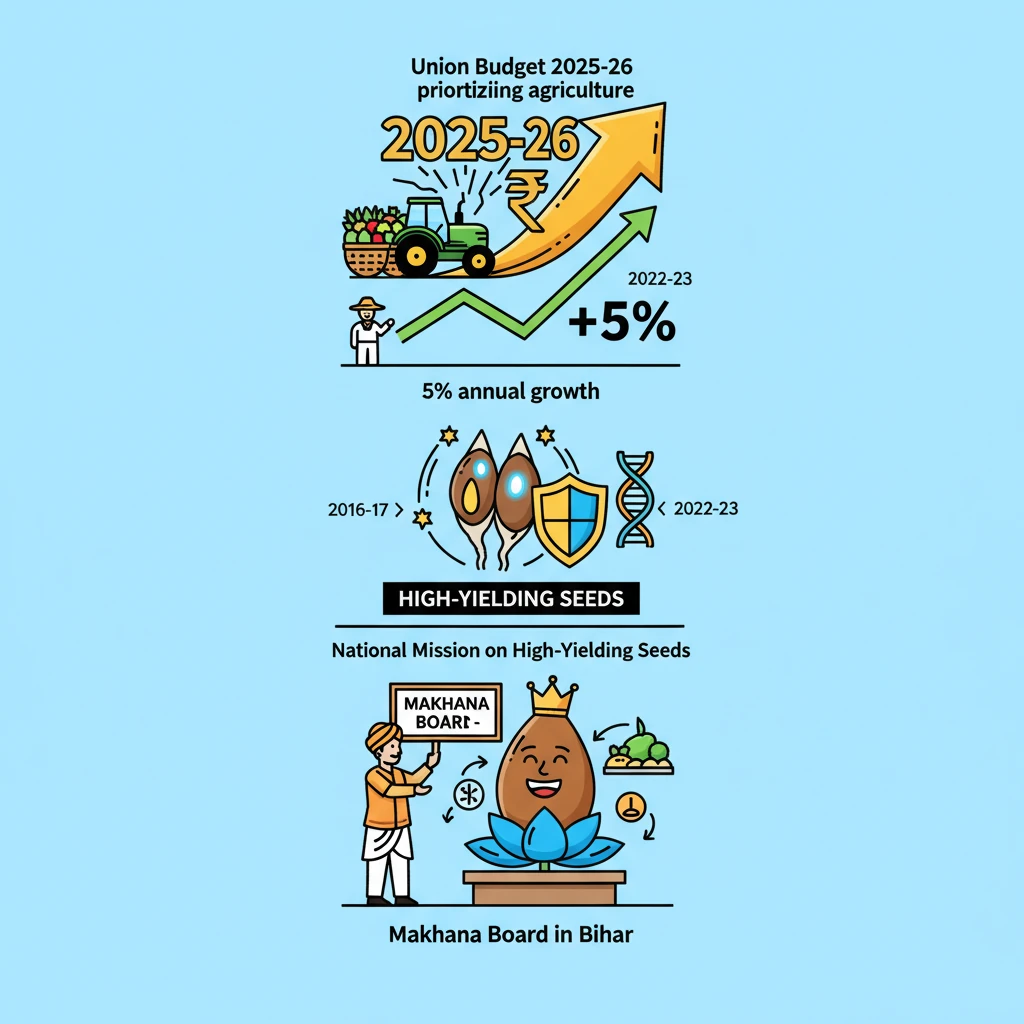
<h4>Overview of Agriculture Development in India</h4><p>The <strong>Union Budget 2025-26</strong> emphasizes <strong>'Agriculture as the first engine'</strong> for India's development journey.</p><p>It announced a series of measures aimed at spurring <strong>agricultural growth</strong> and <strong>productivity</strong>.</p><div class="info-box"><strong>Economic Survey 2024-25</strong> findings:<br>The <strong>agriculture sector</strong> showed <strong>robust growth</strong>, averaging <strong>5% annually</strong> from <strong>2016-17 to 2022-23</strong>.</div><div class="exam-tip-box">While promoting growth, initiatives like the <strong>National Mission on High-Yielding Seeds</strong> raise concerns regarding potential <strong>monocultures</strong> and the loss of <strong>crop diversity</strong>, a crucial point for UPSC mains answers on sustainability.</div><h4>Key Agricultural Initiatives from Union Budget 2025-26</h4><p>The <strong>Union Budget 2025-26</strong> introduced several key initiatives to boost the agriculture sector:</p><ul><li><strong>National Mission on High Yielding Seeds</strong></li><li>Establishment of a <strong>Makhana Board in Bihar</strong></li><li>Promotion of <strong>Food Processing</strong> with a new institute</li><li>Setting up of a <strong>second Gene Bank</strong></li></ul><h4>National Mission on High Yielding Seeds</h4><p>This mission aims to significantly improve <strong>agricultural productivity</strong> across India.</p><p>Its primary goal is to develop and disseminate <strong>high-yielding seeds</strong> that are more resilient to various environmental and biological stressors.</p><div class="key-point-box"><strong>Core Objectives:</strong><ul><li>Develop new <strong>seed varieties</strong> with enhanced productivity and resistance.</li><li>Create seeds specifically resilient to <strong>pests</strong> and <strong>climate stress</strong>.</li><li>Ensure easy and widespread access to these <strong>high-yielding seeds</strong> for farmers.</li></ul></div><div class="info-box"><strong>Target:</strong> Increase the availability of over <strong>100 new seed varieties</strong>, including <strong>23 cereals</strong>, <strong>11 pulses</strong>, and <strong>7 oilseeds</strong>.</div><h4>Makhana Board in Bihar</h4><p>A dedicated <strong>Makhana Board</strong> will be established in <strong>Bihar</strong>, a key region for <strong>Makhana</strong> (fox nut) production.</p><p>The board's mandate is to provide comprehensive support to <strong>Makhana farmers</strong>.</p><div class="key-point-box"><strong>Functions of the Makhana Board:</strong><ul><li>Boost <strong>Makhana production</strong>.</li><li>Enhance <strong>processing capabilities</strong>.</li><li>Strengthen <strong>marketing channels</strong>.</li><li>Support farmers through <strong>Farmer Producer Organizations (FPOs)</strong> and existing <strong>government schemes</strong>.</li></ul></div><h4>Food Processing Initiatives</h4><p>The union government is committed to promoting <strong>food processing activities</strong>, particularly in <strong>Eastern India</strong>.</p><p>This is expected to add value to agricultural produce, reduce wastage, and create employment.</p><div class="info-box"><strong>Key Establishment:</strong> A <strong>National Institute of Food Technology, Entrepreneurship and Management (NIFTEM)</strong> will be established in <strong>Bihar</strong>.</div><h4>Gene Bank for Future Security</h4><p>A significant step towards long-term <strong>food and nutritional security</strong> is the establishment of a <strong>second Gene Bank</strong>.</p><p>This new facility will complement the existing infrastructure for preserving genetic resources.</p><div class="info-box"><strong>Details:</strong><ul><li>This will be India's <strong>second Gene Bank</strong> (the <strong>first</strong> was established in <strong>1996</strong>).</li><li>It will store <strong>10 lakh germplasm lines</strong>.</li></ul></div><div class="key-point-box"><strong>Definition of a Gene Bank:</strong> A facility designed to store and preserve <strong>genetic material</strong> from plants, animals, or microorganisms for future use, crucial for biodiversity and crop improvement.</div>
💡 Key Takeaways
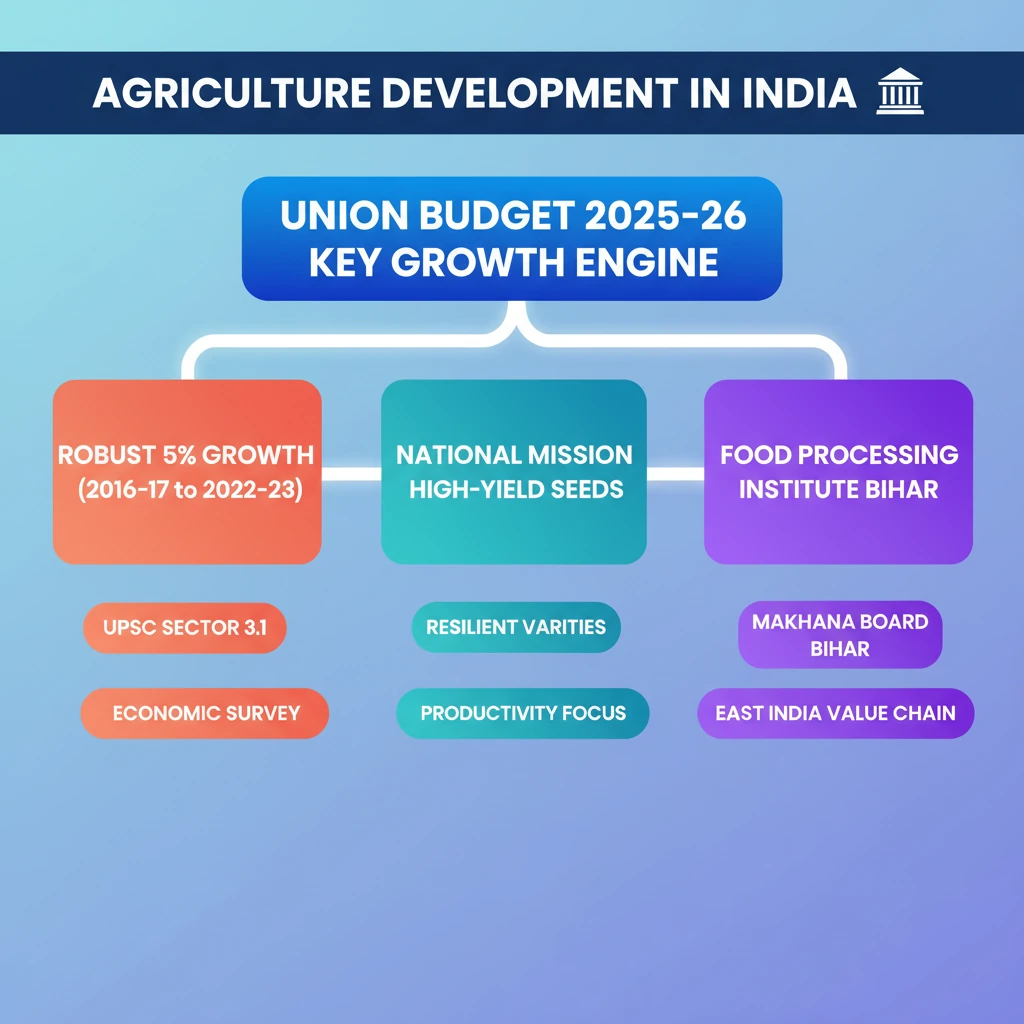
- •Union Budget 2025-26 prioritizes agriculture as a key growth engine.
- •Agriculture sector showed robust 5% annual growth from 2016-17 to 2022-23.
- •National Mission on High-Yielding Seeds aims for resilient, productive varieties.
- •Makhana Board in Bihar targets boosting production and marketing of fox nuts.
- •New food processing institute in Bihar will promote eastern India's agricultural value chain.
- •A second Gene Bank with 10 lakh germplasm lines is vital for future food security.
- •Concerns exist regarding monocultures and loss of crop diversity with high-yielding seeds.
🧠 Memory Techniques
95% Verified Content