What are the Recommendations of the NITI Aayog Report? - Agriculture Allied Sector | UPSC Learning
Topics
0 topics • 0 completed
🔍
No topics match your search
What are the Recommendations of the NITI Aayog Report?
Medium⏱️ 7 min read
agriculture allied sector
📖 Introduction
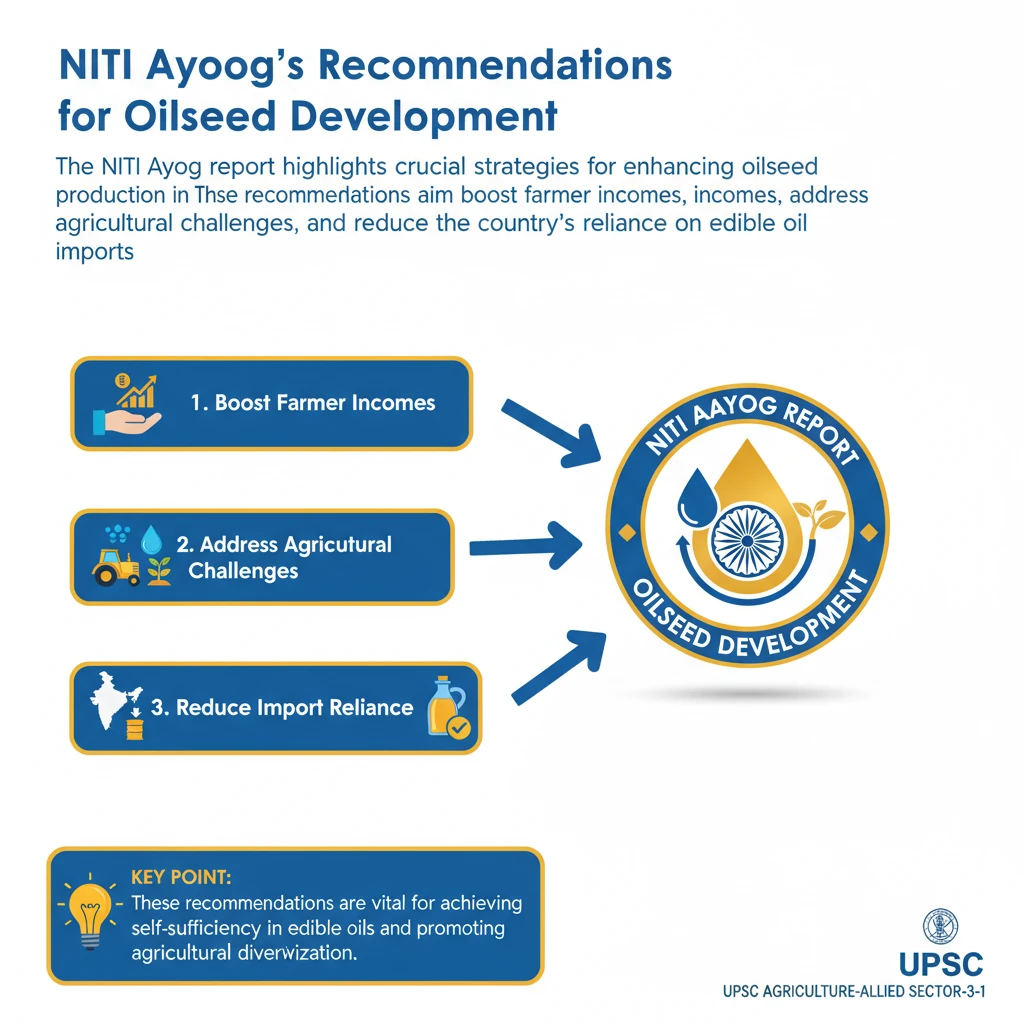
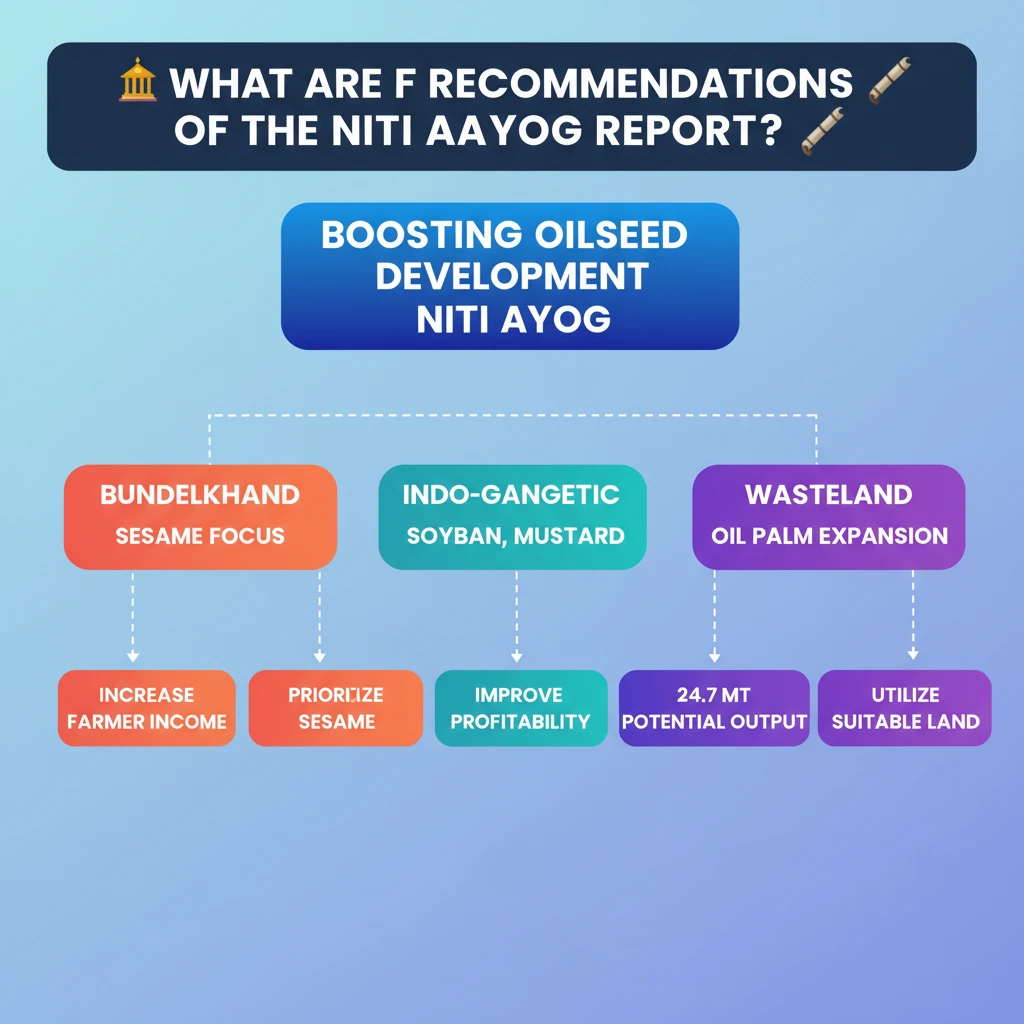
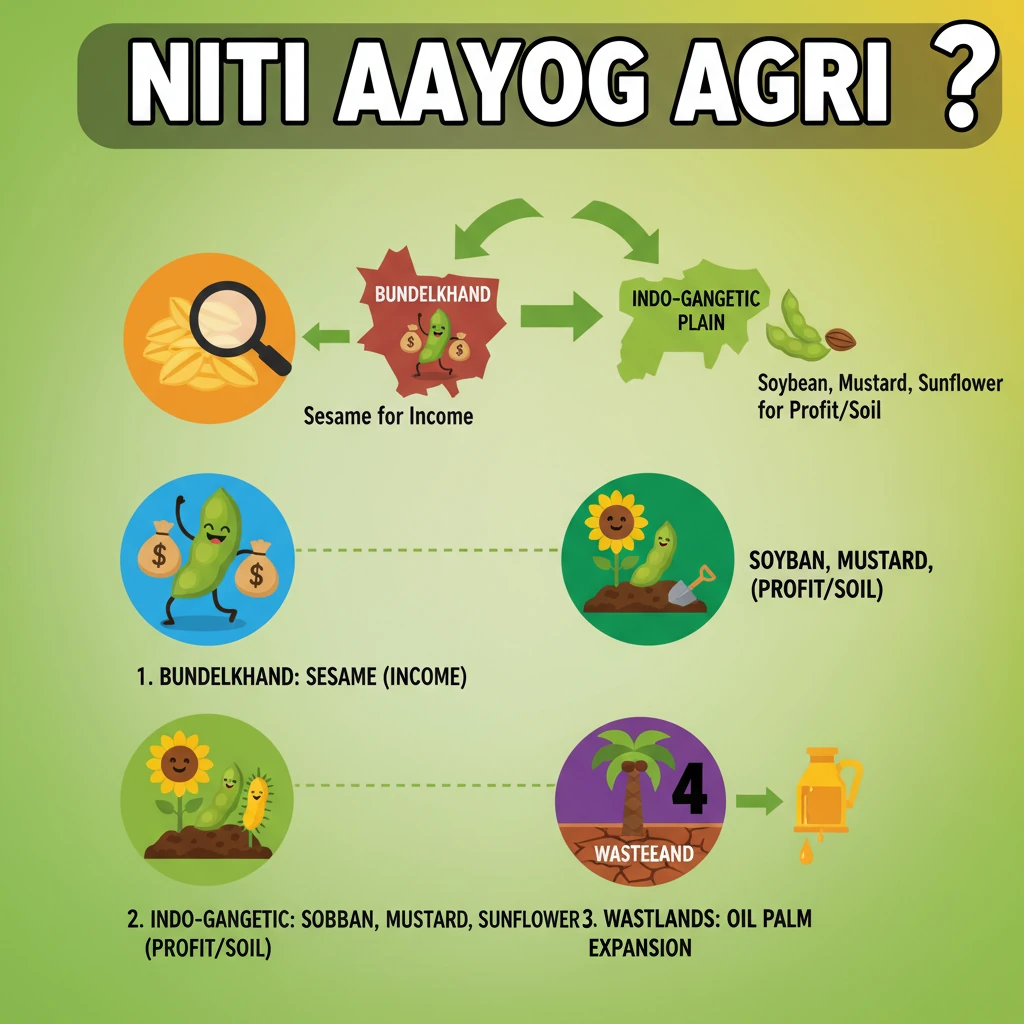
<h4>NITI Aayog's Recommendations for Oilseed Development</h4><p>The <strong>NITI Aayog report</strong> highlights crucial strategies for enhancing <strong>oilseed production</strong> in India. These recommendations aim to boost farmer incomes, address agricultural challenges, and reduce the country's reliance on edible oil imports.</p><div class="key-point-box">These recommendations are vital for achieving <strong>self-sufficiency</strong> in edible oils and promoting agricultural diversification.</div><h4>Enhancing Oilseed Development in Specific Regions</h4><p>The report strongly advocates for revitalizing <strong>oilseed cultivation</strong> in key agricultural regions. This includes both traditional and non-traditional areas, focusing on suitable crops for each.</p><h5>Bundelkhand Region Focus</h5><p><strong>Bundelkhand</strong> is identified as a priority area for enhanced <strong>oilseed development</strong>. The focus here is on crops that can thrive in its specific agro-climatic conditions.</p><div class="info-box"><strong>Target Region:</strong> Bundelkhand<br><strong>Primary Oilseed:</strong> <strong>Sesame</strong><br><strong>Objective:</strong> To significantly boost farmer incomes through increased production.</div><h5>Indo-Gangetic Plain Initiatives</h5><p>The <strong>Indo-Gangetic Plain</strong>, a highly fertile region, is also targeted for introducing new <strong>oilseed crops</strong>. This diversification aims to improve profitability for farmers and address prevalent soil and water management issues.</p><div class="info-box"><strong>Target Region:</strong> Indo-Gangetic Plain<br><strong>Introduced Oilseeds:</strong> <strong>Soybean</strong>, <strong>Rapeseed-Mustard</strong>, and <strong>Sunflower</strong><br><strong>Objectives:</strong> Increase farm profitability, mitigate soil degradation, and improve water use efficiency.</div><h4>Prioritising Wasteland Utilisation for Oil Palm Expansion</h4><p>A significant recommendation involves leveraging <strong>wastelands</strong> for expanding <strong>oil palm cultivation</strong>. This strategy not only utilizes otherwise unproductive land but also has a substantial impact on overall oilseed production.</p><div class="info-box"><strong>Focus Area:</strong> Suitable <strong>wastelands</strong> across India<br><strong>Crop:</strong> <strong>Oil Palm</strong><br><strong>Potential Production Increase:</strong> An estimated <strong>24.7 MT</strong> (Million Tonnes) of additional production.</div><div class="exam-tip-box">Understanding the regional focus (<strong>Bundelkhand</strong>, <strong>Indo-Gangetic Plain</strong>) and the specific crops recommended (<strong>sesame</strong>, <strong>soybean</strong>, <strong>rapeseed-mustard</strong>, <strong>sunflower</strong>, <strong>oil palm</strong>) is crucial for <strong>UPSC Prelims</strong>. The potential production figures (<strong>24.7 MT</strong>) are also important for <strong>Mains answers</strong> on agricultural economy.</div>
💡 Key Takeaways
- •NITI Aayog recommends boosting oilseed development in Bundelkhand and the Indo-Gangetic Plain.
- •Sesame is prioritized for Bundelkhand to increase farmer incomes.
- •Soybean, rapeseed-mustard, and sunflower are suggested for the Indo-Gangetic Plain to improve profitability and address soil issues.
- •Utilizing suitable wastelands for oil palm expansion is a key strategy.
- •Oil palm cultivation on wastelands has the potential to add 24.7 MT to production.
- •These recommendations aim to reduce India's edible oil import dependency and enhance farmer welfare.
- •The strategies align with the broader goals of agricultural diversification and sustainable land use.
🧠 Memory Techniques
98% Verified Content
📚 Reference Sources
•NITI Aayog Official Website (for general role and reports)
•Ministry of Agriculture & Farmers Welfare (for schemes like NMEO-OP, NFSM)
•Press Information Bureau (PIB) releases on agricultural policies