Lentil Production India - Agriculture Allied Sector | UPSC Learning
Topics
0 topics • 0 completed
🔍
No topics match your search
Lentil Production India
Medium⏱️ 8 min read
agriculture allied sector
📖 Introduction
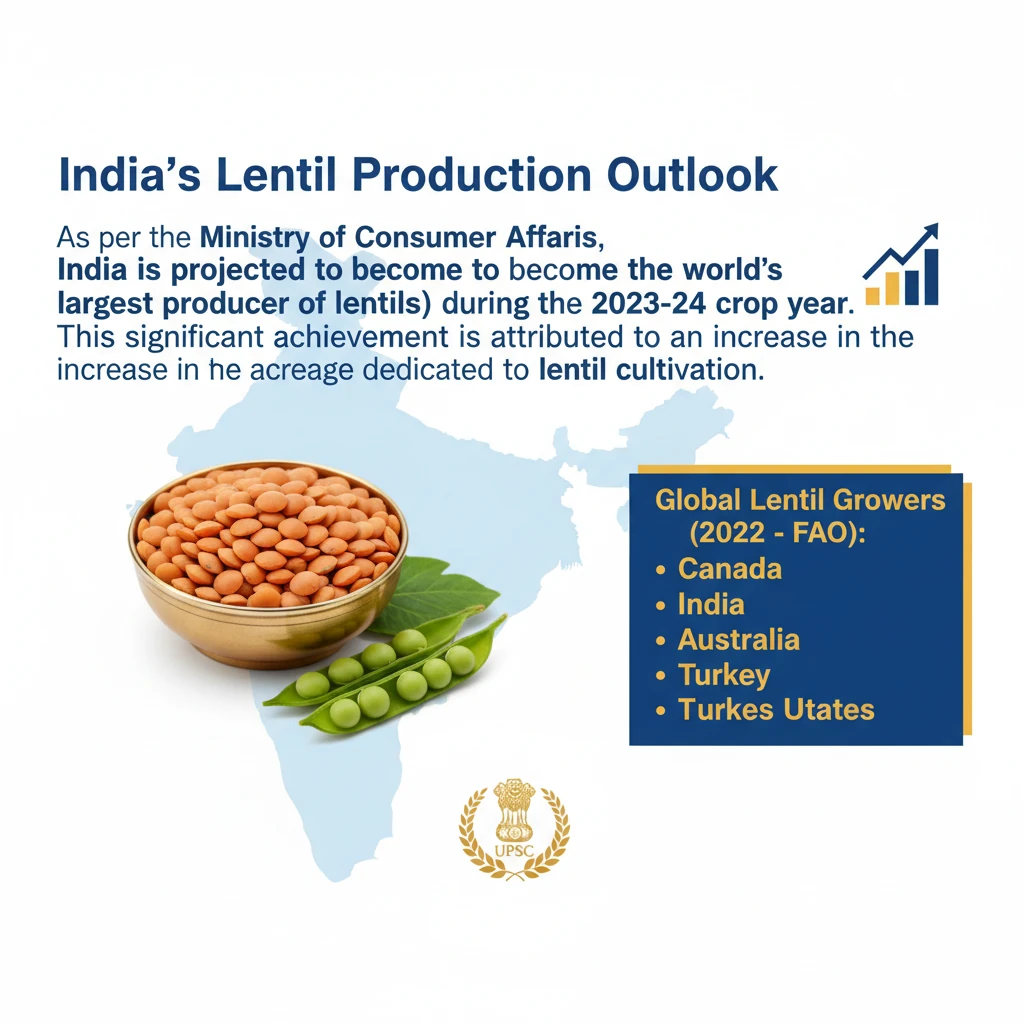
<h4>India's Lentil Production Outlook</h4><p>As per the <strong>Ministry of Consumer Affairs</strong>, India is projected to become the <strong>world's largest producer of lentils (masoor)</strong> during the <strong>2023-24 crop year</strong>. This significant achievement is attributed to an increase in the acreage dedicated to lentil cultivation.</p><div class="info-box"><strong>Global Lentil Growers (2022 - FAO):</strong><ul><li><strong>Canada</strong></li><li><strong>India</strong></li><li><strong>Australia</strong></li><li><strong>Turkey</strong></li><li><strong>Russia</strong></li></ul></div><h4>About Lentils: Characteristics</h4><p>Lentil is a <strong>bushy annual herbaceous plant</strong> belonging to the <strong>legume family</strong>. These plants are typically short in stature and bear <strong>self-pollinated flowers</strong>.</p><div class="info-box"><strong>Nutritional Profile of Lentils:</strong>Excellent sources of:<ul><li><strong>Energy</strong></li><li><strong>Carbohydrates</strong></li><li><strong>Protein</strong></li><li><strong>Fat</strong></li><li><strong>Fibers</strong></li><li><strong>Phosphorus</strong></li><li><strong>Iron</strong></li><li><strong>Zinc</strong></li><li><strong>Carotene</strong></li><li><strong>Vitamins</strong></li><li><strong>Antioxidants</strong></li></ul></div><h4>Lentil Cultivation Conditions</h4><p>Lentils are primarily grown as a <strong>rabi crop</strong> in India, typically cultivated as a <strong>rainfed crop</strong>. They require specific climatic conditions for optimal growth.</p><p>During its <strong>vegetative growth</strong> phase, lentils thrive in <strong>cold temperatures</strong>. However, at the time of <strong>maturity</strong>, they necessitate a <strong>warm temperature</strong> to complete their life cycle.</p><h4>Key Lentil Growing Regions</h4><p>Lentil cultivation is concentrated in several states across India. These regions provide the suitable climatic and soil conditions for the crop.</p><ul><li><strong>Uttar Pradesh</strong></li><li><strong>Madhya Pradesh</strong></li><li><strong>Bihar</strong></li><li><strong>West Bengal</strong></li><li><strong>Chhattisgarh</strong></li><li><strong>Jharkhand</strong></li></ul><p>The <strong>Bundelkhand region</strong>, spanning parts of <strong>Uttar Pradesh</strong> and <strong>Madhya Pradesh</strong>, is notably considered a <strong>'lentil bowl'</strong>. This region alone contributes nearly <strong>25%</strong> to the total lentil production in India.</p><h4>Status of Pulse Production in India</h4><p>India holds a pre-eminent position in the global pulse market. It is the <strong>largest producer</strong>, <strong>largest consumer</strong>, and a significant <strong>importer</strong> of pulses worldwide.</p><div class="key-point-box"><strong>India's Global Share in Pulses:</strong><ul><li><strong>Production:</strong> 25% of global production</li><li><strong>Consumption:</strong> 27% of world consumption</li><li><strong>Import:</strong> 14% of global imports</li></ul></div><p>Pulses collectively account for approximately <strong>20% of the total area under food grains</strong> in the country. They contribute around <strong>7-10%</strong> to the total foodgrain production.</p><h4>Dominant Pulse Varieties in India</h4><p>Among various pulse varieties, <strong>Gram</strong> is the most dominant, accounting for around <strong>40%</strong> of the total pulse production. Other significant pulses follow in contribution.</p><ul><li><strong>Tur/Arhar:</strong> 15 to 20%</li><li><strong>Urad/Black Matpe:</strong> 8-10%</li><li><strong>Moong:</strong> 8-10%</li></ul>
💡 Key Takeaways
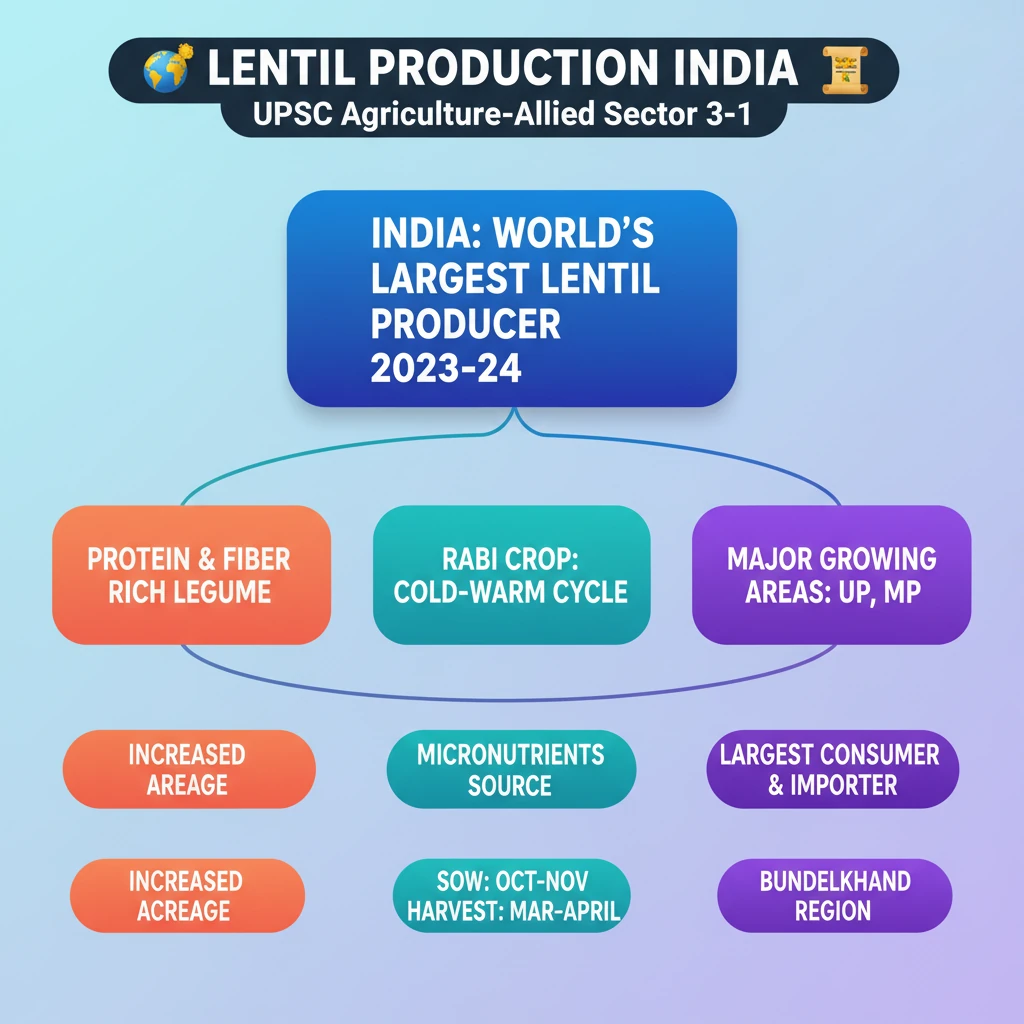
- •India is projected to be the world's largest lentil producer in 2023-24 due to higher acreage.
- •Lentils are a bushy annual herbaceous legume, rich in protein, fiber, and micronutrients.
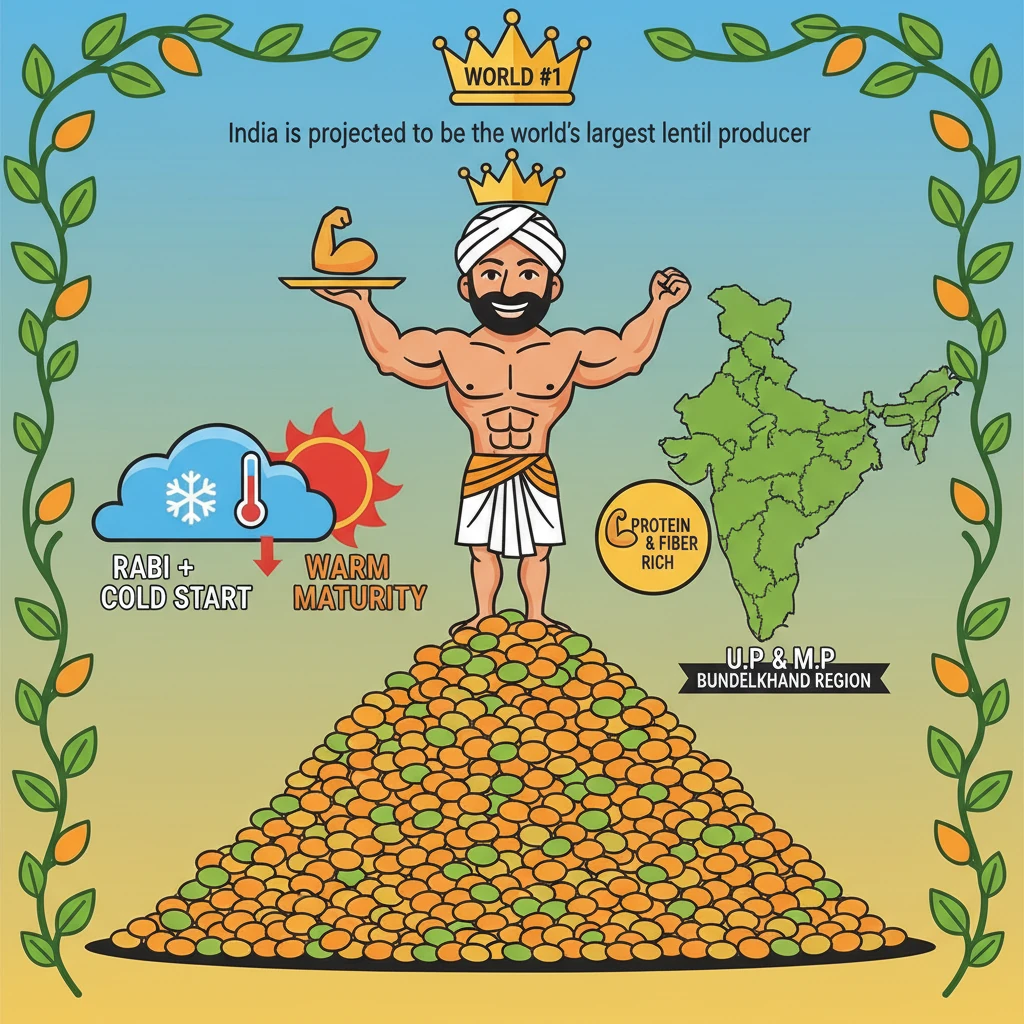
- •They are a rabi crop requiring cold temperatures for growth and warm temperatures for maturity.
- •Uttar Pradesh and Madhya Pradesh, especially the Bundelkhand region, are major lentil-growing areas.
- •India is the largest producer, consumer, and importer of pulses globally.
- •Pulses contribute significantly to India's foodgrain area and production, with Gram being the dominant variety.
🧠 Memory Techniques
98% Verified Content
📚 Reference Sources
•Food and Agriculture Organization (FAO)
•Drishti IAS Summary on Lentil Production India