Haber-Bosch Process and Production of Fertilizers - Agriculture Allied Sector | UPSC Learning
Topics
0 topics • 0 completed
🔍
No topics match your search
Haber-Bosch Process and Production of Fertilizers
Medium⏱️ 7 min read
agriculture allied sector
📖 Introduction
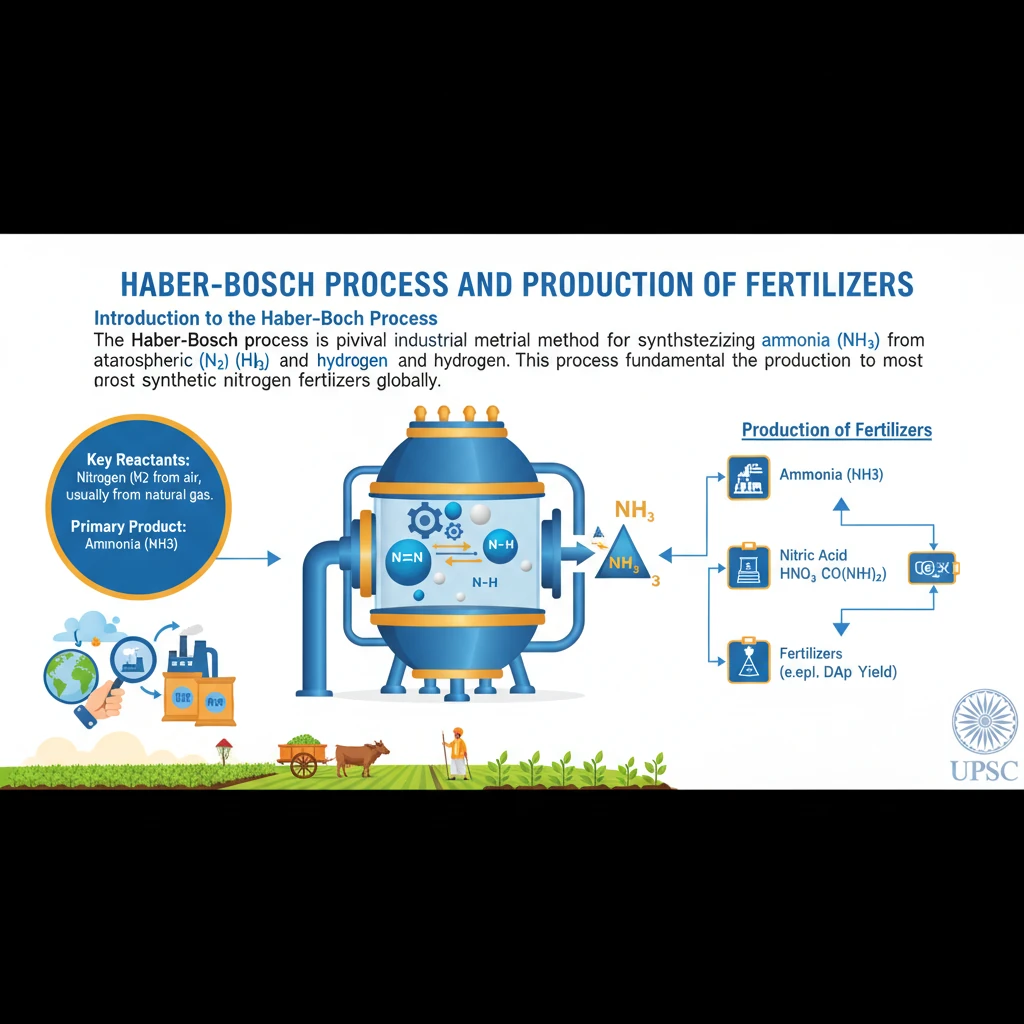
<h4>Introduction to the Haber-Bosch Process</h4><p>The <strong>Haber-Bosch process</strong> is a pivotal industrial method for synthesizing <strong>ammonia (NH3)</strong> from atmospheric <strong>nitrogen (N2)</strong> and <strong>hydrogen (H2)</strong>. This process is fundamental to the production of most synthetic nitrogen fertilizers globally.</p><div class="info-box"><strong>Key Reactants:</strong> Nitrogen (N2) from air, Hydrogen (H2) usually from natural gas.<br><strong>Primary Product:</strong> Ammonia (NH3).</div><h4>Mechanism of the Process</h4><p>The process involves reacting nitrogen gas and hydrogen gas under specific conditions. These conditions include very <strong>high temperatures</strong> (typically 400-500°C) and <strong>high pressures</strong> (150-350 atmospheres), in the presence of an <strong>iron-based catalyst</strong>.</p><p>The chemical reaction is reversible, and the carefully controlled conditions are designed to maximize the yield of ammonia. The ammonia produced is then used as a direct fertilizer or as a precursor for other nitrogenous fertilizers.</p><h4>Global Nitrogen Production and Impact</h4><p>Through the <strong>Haber-Bosch process</strong>, an immense quantity of nitrogen is extracted from the atmosphere. Approximately <strong>hundred million tonnes</strong> of atmospheric nitrogen are transformed into fertilizer annually.</p><p>This industrial output results in the addition of about <strong>140 million tonnes</strong> of <strong>reactive nitrogen</strong> to the soil each year. This figure highlights the massive scale and impact of the process on global agricultural productivity.</p><div class="key-point-box"><strong>Reactive Nitrogen:</strong> Nitrogen compounds (like ammonia, nitrates) that are biologically active and can participate in biogeochemical cycles, unlike inert atmospheric N2.</div><h4>Comparison with Natural Nitrogen Fixation</h4><p>The contribution of the Haber-Bosch process to the global nitrogen cycle is comparable to, and often exceeds, natural processes. Natural biological processes, such as those carried out by nitrogen-fixing bacteria, generate an estimated <strong>100-140 million tonnes</strong> of reactive nitrogen annually.</p><p>This comparison underscores the profound human impact on the Earth's nitrogen cycle, significantly altering the availability of a crucial nutrient for plant growth.</p><div class="exam-tip-box">For <strong>UPSC Mains GS-III</strong>, understanding the scale of the Haber-Bosch process and its comparison with natural cycles is crucial for questions on agriculture, environment, and food security.</div>

💡 Key Takeaways
- •The Haber-Bosch process synthesizes ammonia from atmospheric nitrogen and hydrogen.
- •It produces hundreds of millions of tonnes of reactive nitrogen for fertilizers annually.
- •Its output is comparable to or exceeds natural biological nitrogen fixation.
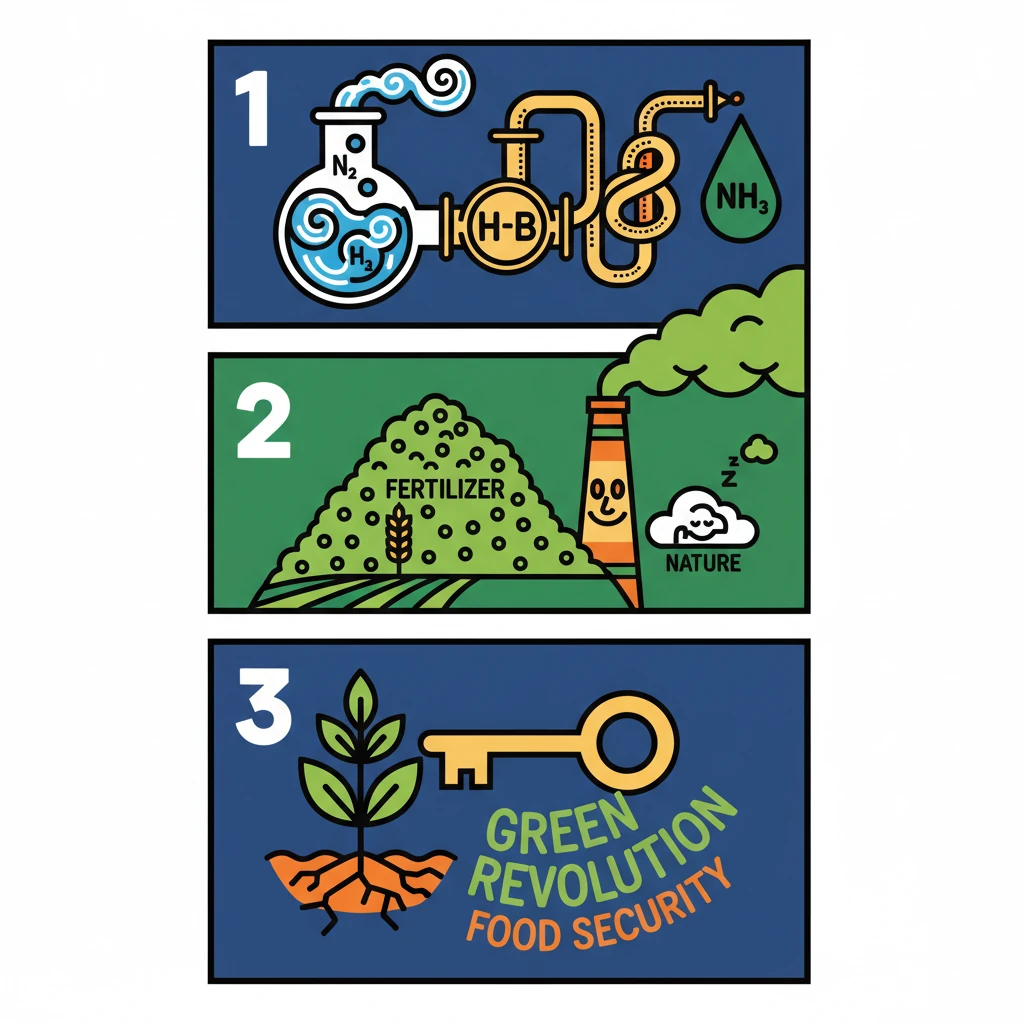
- •The process was critical for the Green Revolution, ensuring global food security.
- •It is energy-intensive and contributes to greenhouse gas emissions and water pollution.
- •Government policies like fertilizer subsidies and Neem-coated Urea aim to manage its use.
🧠 Memory Techniques
95% Verified Content
📚 Reference Sources
•NCERT Chemistry Textbooks (Class 11 & 12)
•Environmental Science textbooks (e.g., Shankar IAS Environment)
•FAO reports on global fertilizer use and food security
•Academic articles on the Haber-Bosch process and its environmental impact