What is the Edible Oil Scenario in India’s Economy? - Agriculture Allied Sector | UPSC Learning
Topics
0 topics • 0 completed
🔍
No topics match your search
What is the Edible Oil Scenario in India’s Economy?
Medium⏱️ 6 min read
agriculture allied sector
📖 Introduction
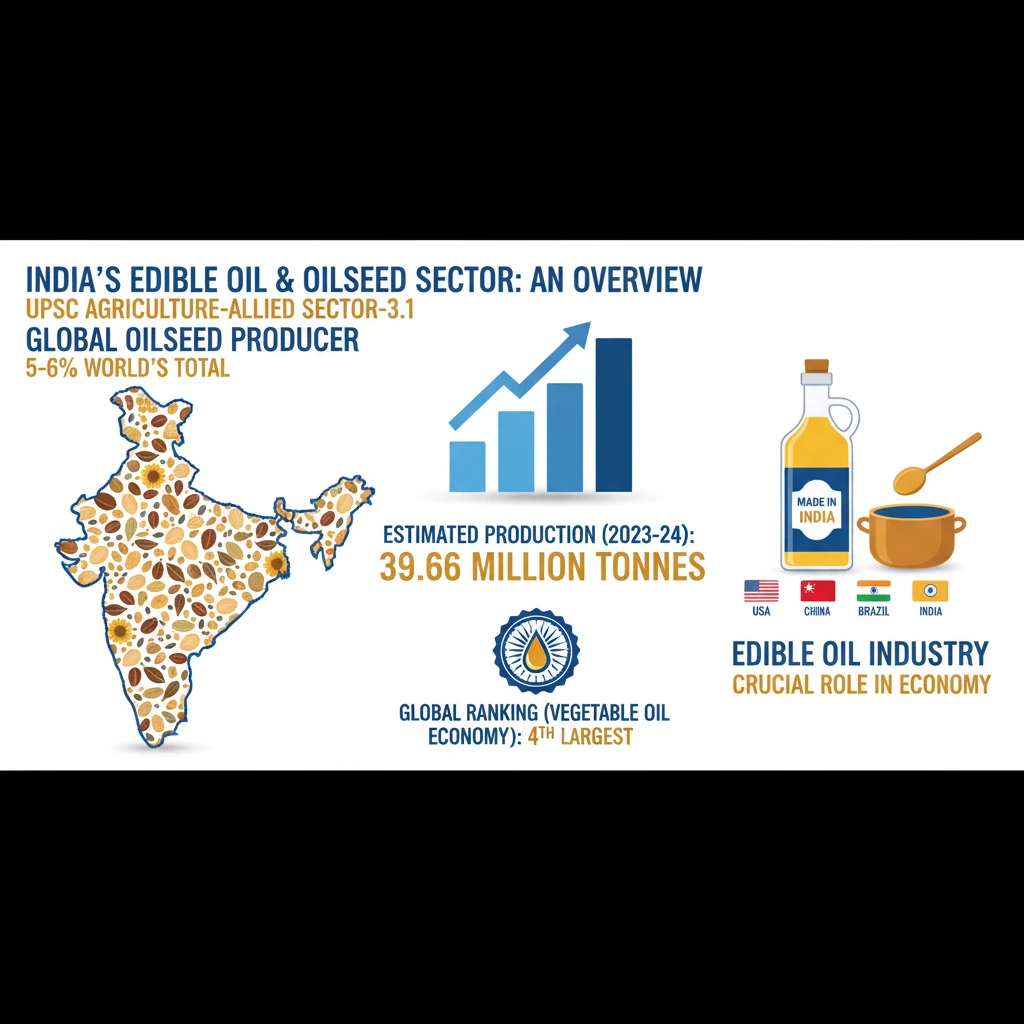
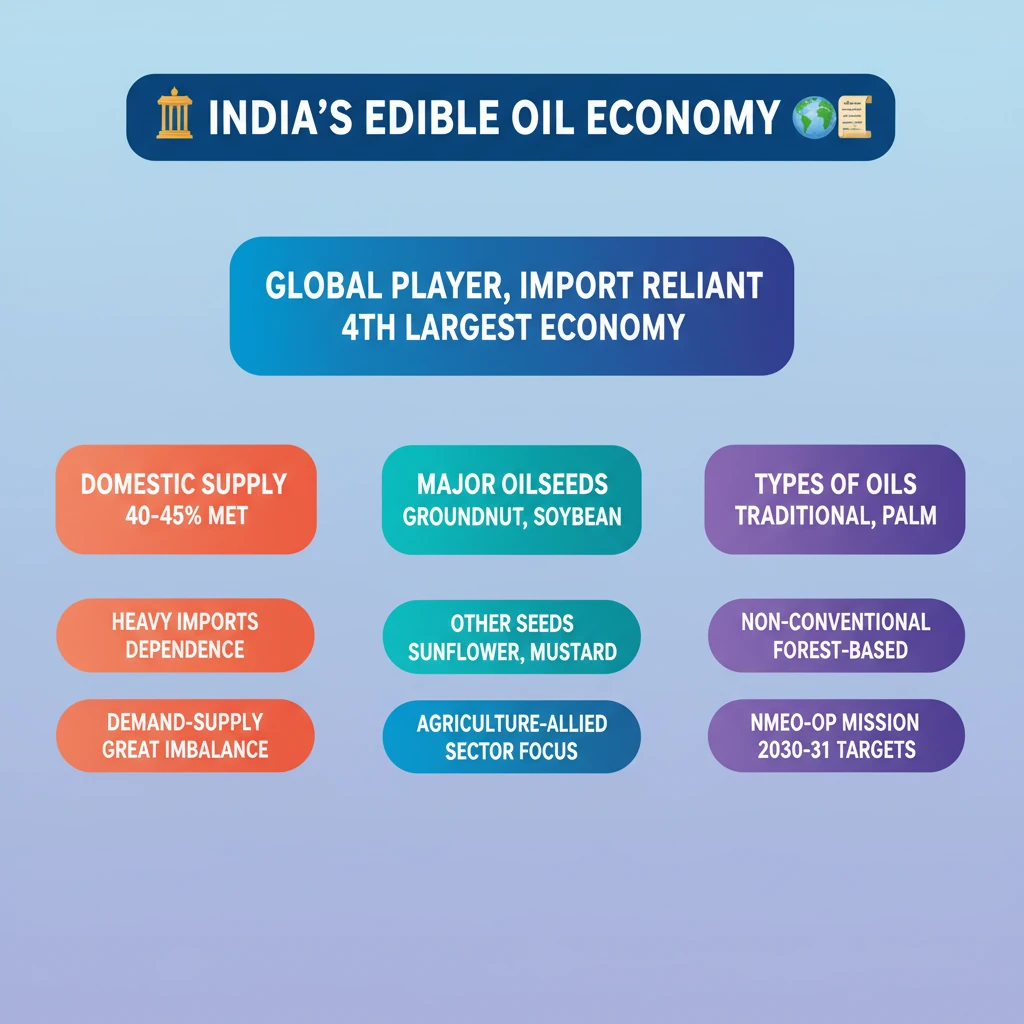
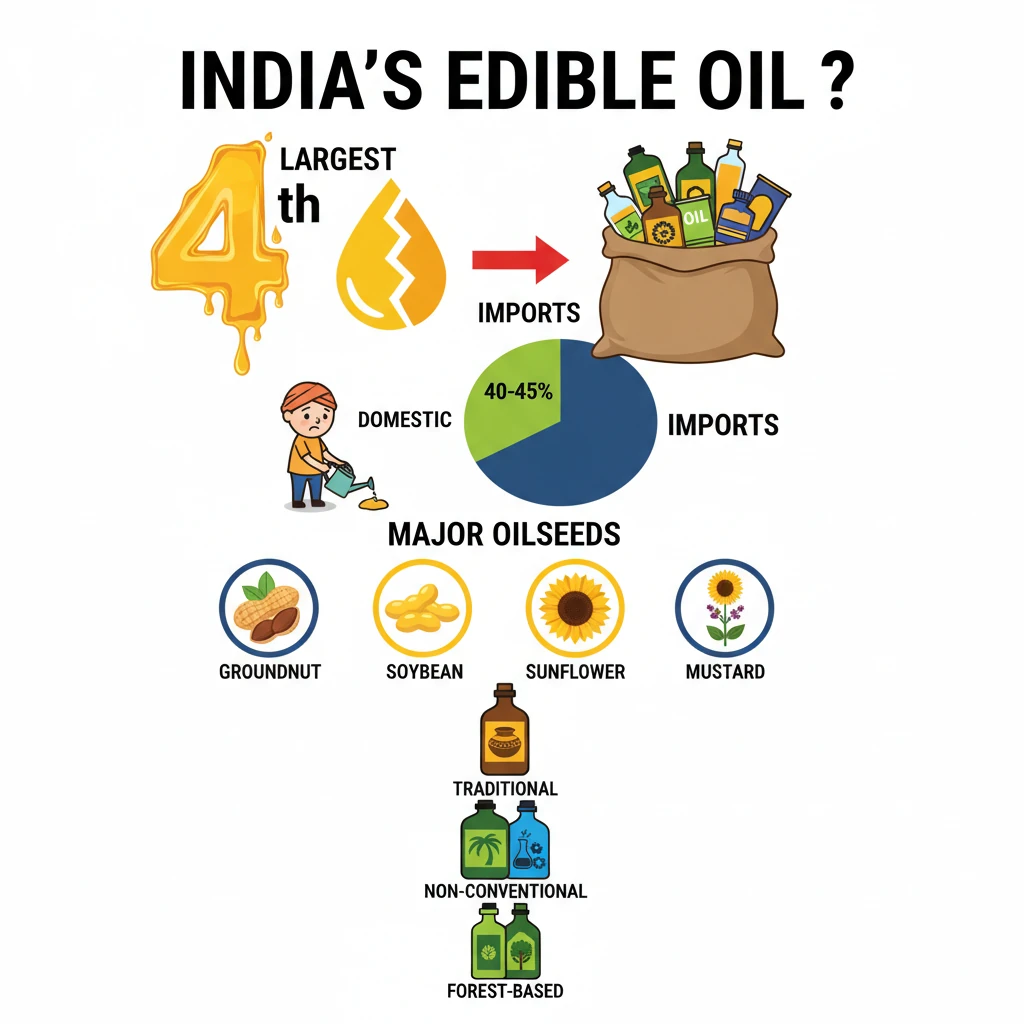
<h4>India's Edible Oil and Oilseed Sector: An Overview</h4><p>India stands as one of the <strong>largest oilseed producers globally</strong>, contributing approximately <strong>5-6%</strong> to the world's total production.</p><div class="info-box"><strong>Estimated Production (2023-24):</strong> 39.66 million tonnes<br><strong>Global Ranking (Vegetable Oil Economy):</strong> Fourth largest (after <strong>USA, China, Brazil</strong>)</div><p>The <strong>edible oil industry</strong> plays a crucial role in India's agriculture and trade sectors, impacting both rural livelihoods and national economics.</p><div class="info-box"><strong>Oilseed & Oil Meal Imports (2023-24):</strong> Valued at <strong>Rs 29,587 crore</strong><br><strong>Edible Oil Imports (2022-23):</strong> <strong>16.5 million tonnes (MT)</strong></div><p>Despite significant domestic production, India's supply fulfills only <strong>40-45%</strong> of its edible oil requirements. This leads to a substantial import dependency, with <strong>57%</strong> of consumption met through imports.</p><h4>Major Oilseeds Cultivated in India</h4><p>India cultivates a diverse range of <strong>oilseeds</strong>, which are vital for domestic edible oil production and agricultural diversity.</p><ul><li><strong>Groundnut</strong></li><li><strong>Soybean</strong></li><li><strong>Sunflower</strong></li><li><strong>Mustard</strong></li><li><strong>Sesame</strong></li><li><strong>Niger</strong></li><li><strong>Safflower</strong></li></ul><h4>Categories of Edible Oils in India</h4><p>Edible oils in India are broadly categorized based on their source, cultivation methods, and traditional usage.</p><div class="key-point-box">Understanding these categories is crucial for analyzing India's diverse agricultural landscape and consumption patterns.</div><ul><li><strong>Traditional Oils:</strong> These are derived from widely cultivated oilseeds and form the backbone of domestic edible oil production.<ul><li>Examples: <strong>Groundnut, Mustard/Rapeseed, Sesame, Safflower, Linseed, Niger seed, Castor, Soybean, Sunflower</strong>.</li></ul></li><li><strong>Plantation-based Oils:</strong> Derived from perennial crops, typically cultivated in specific agro-climatic zones.<ul><li>Examples: <strong>Coconut, Oil Palm</strong>.</li><li>Key growing regions for <strong>Oil Palm</strong> include <strong>Andhra Pradesh, Karnataka, Tamil Nadu, Kerala, Andaman and Nicobar</strong>.</li></ul></li><li><strong>Non-conventional Oils:</strong> These are often by-products or lesser-known sources that contribute to the overall edible oil supply.<ul><li>Examples: <strong>Rice bran oil, Cottonseed oil</strong>.</li></ul></li><li><strong>Forest-based Oils:</strong> These oils are collected from various tree and forest sources, primarily in <strong>tribal regions</strong>, offering unique regional contributions.</li></ul><h4>Government Initiatives to Boost Domestic Production</h4><p>The Indian government is actively pursuing strategies to reduce the country's high import dependency on edible oils and achieve greater self-reliance.</p><div class="key-point-box">The primary objective of these initiatives is to enhance domestic oilseed production and ensure food security.</div><p>A significant initiative in this direction is the <strong>National Mission on Oilseeds and Oil Palm (NMEO-OP)</strong>, launched to boost indigenous production.</p><div class="info-box"><strong>NMEO-OP Target:</strong> Boost oilseed production from 39 million tonnes to <strong>69.7 million tonnes by 2030-31</strong>.<br><strong>Goal:</strong> Meet <strong>72%</strong> of the country's edible oil demand through domestic production.</div><div class="exam-tip-box">Remember <strong>NMEO-OP</strong> as a key policy initiative. Its targets and objectives are crucial for Mains answers on agricultural policy, food security, and economic self-reliance.</div>
💡 Key Takeaways
- •India is the world's fourth largest vegetable oil economy but heavily relies on imports.
- •Domestic production meets only 40-45% of India's edible oil requirements.
- •Major oilseeds include groundnut, soybean, sunflower, and mustard.
- •Edible oils are categorized into traditional, plantation-based, non-conventional, and forest-based types.
- •The National Mission on Oilseeds and Oil Palm (NMEO-OP) aims to boost domestic production to 69.7 million tonnes by 2030-31.
- •Reducing import dependency is vital for India's food security, farmer income, and trade balance.
🧠 Memory Techniques
98% Verified Content