8th Edition of the National Programme for Organic Production - Agriculture Allied Sector | UPSC Learning
Topics
0 topics • 0 completed
🔍
No topics match your search
8th Edition of the National Programme for Organic Production
Medium⏱️ 7 min read
agriculture allied sector
📖 Introduction
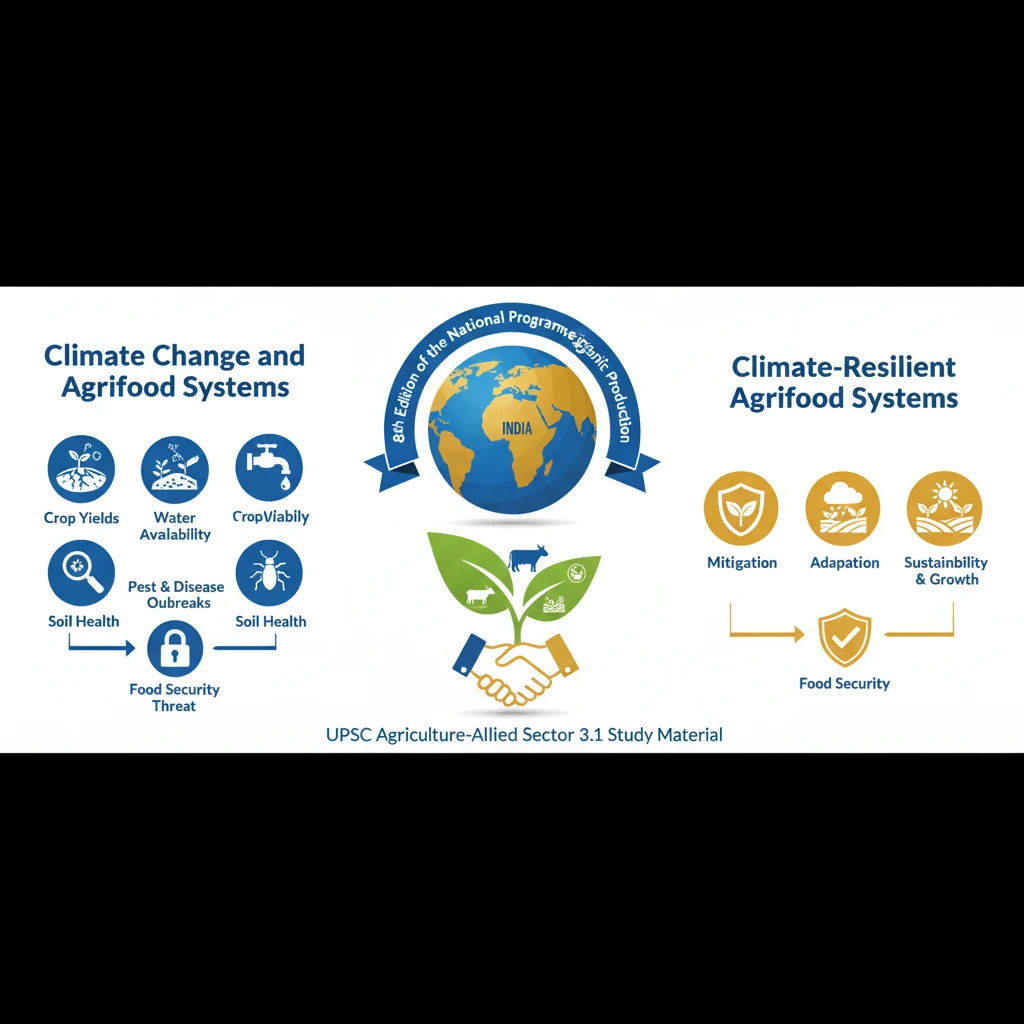
<h4>Climate Change and Agrifood Systems</h4><p><strong>Climate change</strong> significantly impacts agricultural productivity, affecting <strong>crop yields</strong>, <strong>water availability</strong>, and <strong>soil health</strong>. It also leads to increased <strong>pest and disease outbreaks</strong>, posing a direct threat to <strong>food security</strong> globally.</p><p>Developing <strong>climate-resilient agrifood systems</strong> is crucial. These systems help in both mitigating and adapting to climate change, simultaneously enhancing food production, reducing poverty, and improving livelihoods for farming communities.</p><div class="key-point-box"><strong>Climate mainstreaming</strong> into agrifood systems requires substantial investments. This includes larger contributions from <strong>global climate finance</strong>, increased domestic budgets, and significant participation from the <strong>private sector</strong>.</div><h4>Food and Agriculture Organization (FAO)</h4><p>The <strong>Food and Agriculture Organization (FAO)</strong> is a specialized agency of the <strong>United Nations</strong>. Its primary mission is to lead international efforts aimed at defeating hunger and ensuring global food security.</p><p><strong>FAO's goal</strong> is to achieve food security for all. This means ensuring that people worldwide have regular access to sufficient, high-quality food necessary for active, healthy lives.</p><div class="info-box"><strong>Membership:</strong> 194 member countries (including <strong>India</strong>) and the <strong>European Union</strong>.<br><strong>Operations:</strong> Works in over 130 countries worldwide.<br><strong>Headquarters:</strong> 📍 <strong>Rome, Italy</strong>.<br><strong>Sister Organizations:</strong> <strong>World Food Programme (WFP)</strong> and <strong>International Fund for Agricultural Development (IFAD)</strong>.</div><p>The <strong>FAO</strong> publishes several flagship reports that provide critical insights into global food and agriculture trends. These publications are vital for policy-making and research.</p><div class="info-box"><strong>Flagship Publications:</strong><ul><li><strong>The State of World Fisheries and Aquaculture (SOFIA)</strong></li><li><strong>The State of the World’s Forests (SOFO)</strong></li><li><strong>The State of Food Security and Nutrition in the World (SOFI)</strong></li><li><strong>The State of Food and Agriculture (SOFA)</strong></li><li><strong>The State of Agricultural Commodity Markets (SOCO)</strong></li></ul></div><h4>Overview of the National Programme for Organic Production (NPOP)</h4><p>The <strong>National Programme for Organic Production (NPOP)</strong> was initially launched in <strong>2001</strong>. It is implemented by the <strong>Agricultural and Processed Food Products Export Development Authority (APEDA)</strong>, operating under the <strong>Ministry of Commerce & Industries</strong>.</p><p>The core focus of <strong>NPOP</strong> is on the <strong>accreditation of organic production standards</strong> and the active promotion of <strong>organic farming</strong> practices across India. This program is instrumental in formalizing and standardizing organic agriculture.</p><div class="key-point-box"><strong>NPOP</strong> significantly enhances <strong>India’s global competitiveness</strong> in the organic farming sector. Its standards for production and accreditation are officially recognized by the <strong>European Commission</strong> and <strong>Switzerland</strong>.</div><p>This international recognition allows <strong>Indian organic products</strong> to be accepted seamlessly in key global markets, facilitating exports and boosting the domestic organic industry.</p><h4>8th Edition of the National Programme for Organic Production</h4><p>The <strong>8th edition</strong> of the <strong>National Programme for Organic Production (NPOP)</strong> was recently launched in <strong>New Delhi</strong>. This event underscored India’s substantial potential in the growing global organic production market.</p><p>The launch highlighted various <strong>new initiatives</strong> and <strong>technological advancements</strong>. These are specifically designed to further boost organic farming, streamline operational processes, and solidify India's position in the international organic market.</p><h4>Key Highlights: Recognition for Organic Grower Groups</h4><p>A significant highlight of the <strong>8th Edition NPOP</strong> is the enhanced recognition for <strong>Organic Grower Groups</strong>. This includes simplified certification requirements, making it easier for groups of farmers to participate.</p><div class="info-box">The program now grants <strong>legal status</strong> to these <strong>grower groups</strong>. This crucial change replaces the previous <strong>Internal Control System (ICS)</strong>, which was a quality assurance system primarily used for group certification.</div><div class="exam-tip-box"><strong>UPSC Insight:</strong> Understanding the shift from <strong>ICS</strong> to granting <strong>legal status</strong> to grower groups is important. It signifies a move towards formal recognition and empowerment of collective organic farming efforts, which can be a point for Mains questions on agricultural policy.</div><h4>Technological Advancements under 8th Edition NPOP</h4><p>The <strong>8th Edition NPOP</strong> introduces several technological advancements aimed at improving transparency and efficiency in the organic sector.</p><ul><li><strong>NPOP Portal:</strong> This dedicated portal provides enhanced visibility and ease of operations for all <strong>organic stakeholders</strong>, including farmers, certifiers, and buyers.</li><li><strong>Organic Promotion Portal:</strong> This platform actively connects <strong>farmers</strong>, <strong>Farmer Producer Organizations (FPOs)</strong>, and <strong>exporters</strong> with global buyers. It offers valuable trade leads, training opportunities, and information on relevant events.</li><li><strong>TraceNet 2.0:</strong> An upgraded system designed for superior transparency, traceability, and compliance. <strong>TraceNet 2.0</strong> ensures <strong>farm-to-market compliance</strong>, streamlining operations to meet stringent global standards for organic products.</li><li><strong>AgriExchange Portal:</strong> This portal plays a crucial role in facilitating <strong>data analysis</strong> within the agricultural sector. It also serves as a direct connection point for <strong>international buyers and sellers</strong>, fostering global trade.</li></ul>
💡 Key Takeaways
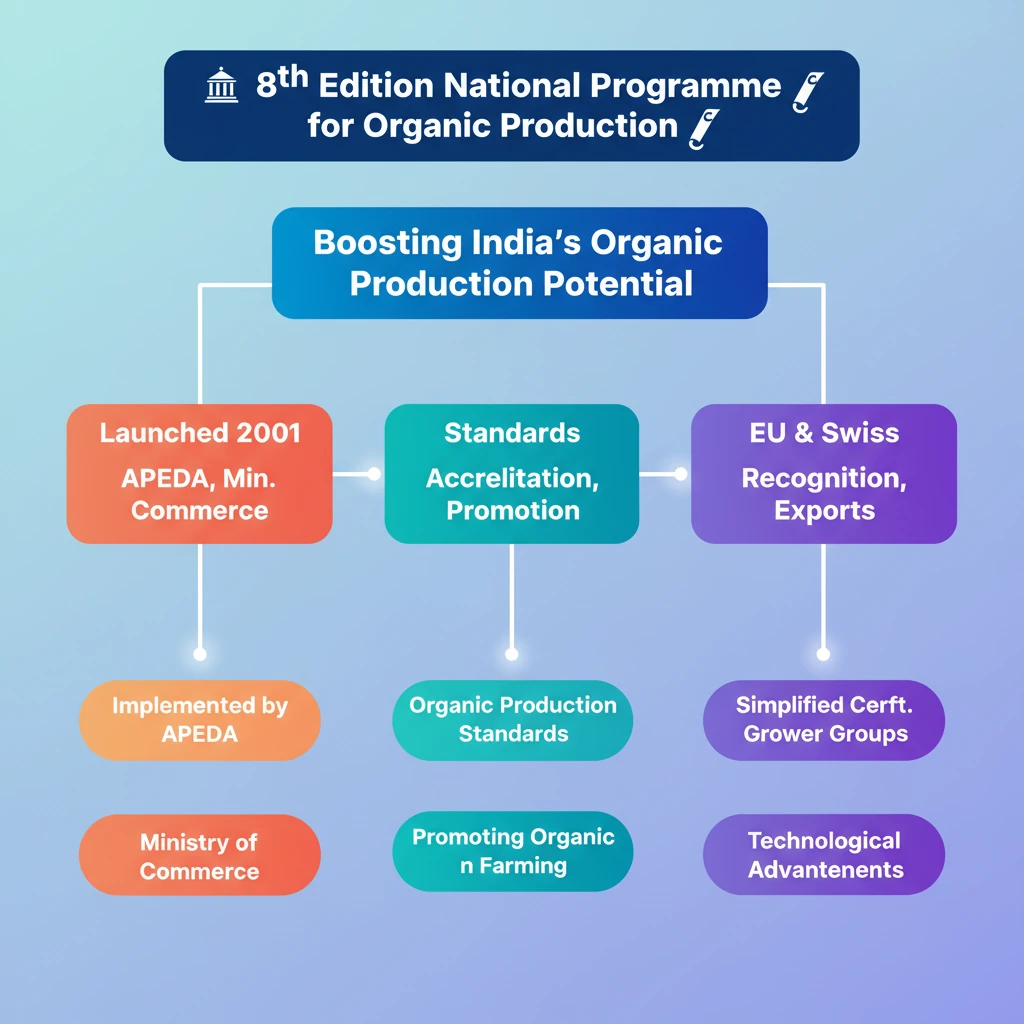
- •The 8th Edition NPOP was launched to boost India's organic production potential.
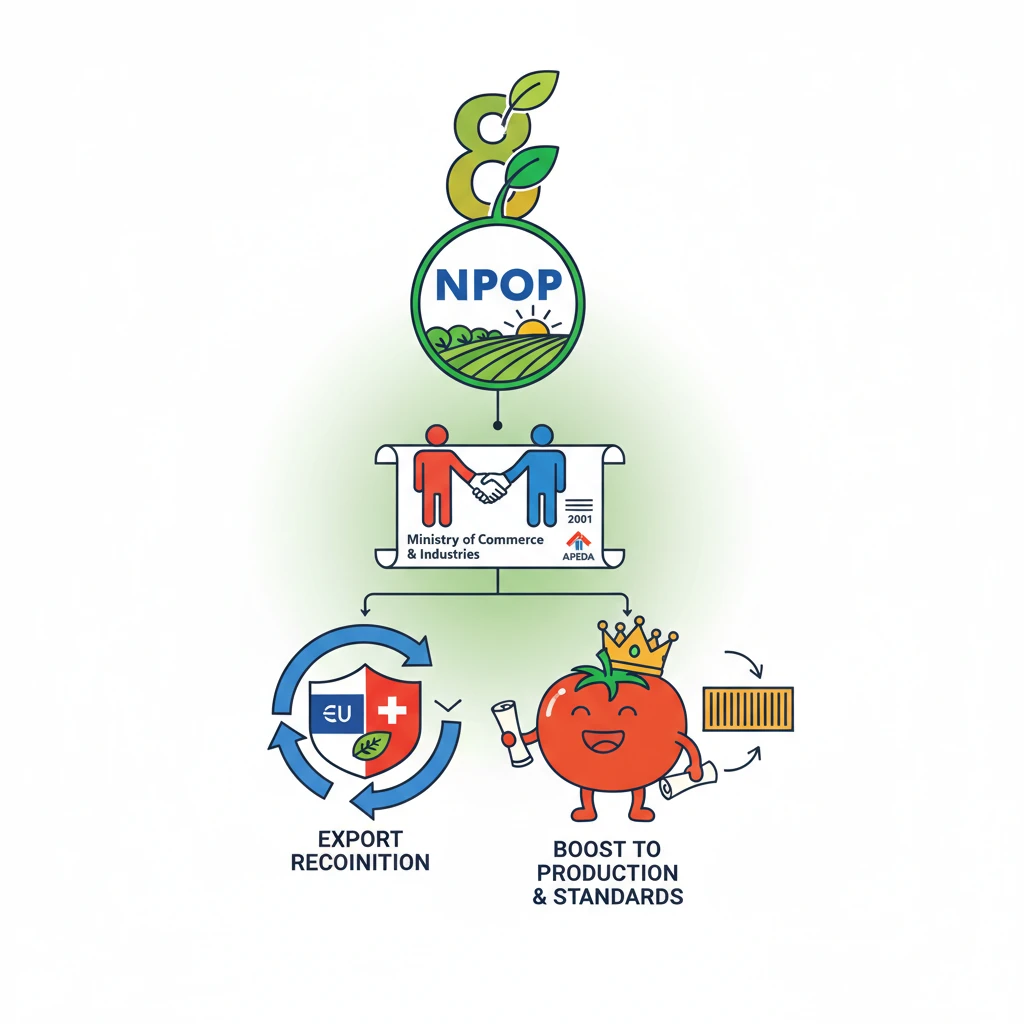
- •NPOP, launched in 2001, is implemented by APEDA under the Ministry of Commerce & Industries.
- •It focuses on organic production standards accreditation and promoting organic farming.
- •NPOP standards are recognized by the European Commission and Switzerland, aiding exports.
- •Key highlights include simplified certification for Organic Grower Groups and new technological advancements.
- •Technological tools like NPOP Portal, Organic Promotion Portal, and TraceNet 2.0 enhance transparency and market access.
- •FAO is a UN agency leading international efforts against hunger, with India as a member.
🧠 Memory Techniques
98% Verified Content
📚 Reference Sources
•National Programme for Organic Production (NPOP) website (APEDA)
•Food and Agriculture Organization (FAO) official website