India-Middle-East-Europe Economic Corridor (IMEC) - economy | UPSC Learning
Topics
0 topics • 0 completed
🔍
No topics match your search
India-Middle-East-Europe Economic Corridor (IMEC)
Medium⏱️ 8 min read
economy
📖 Introduction
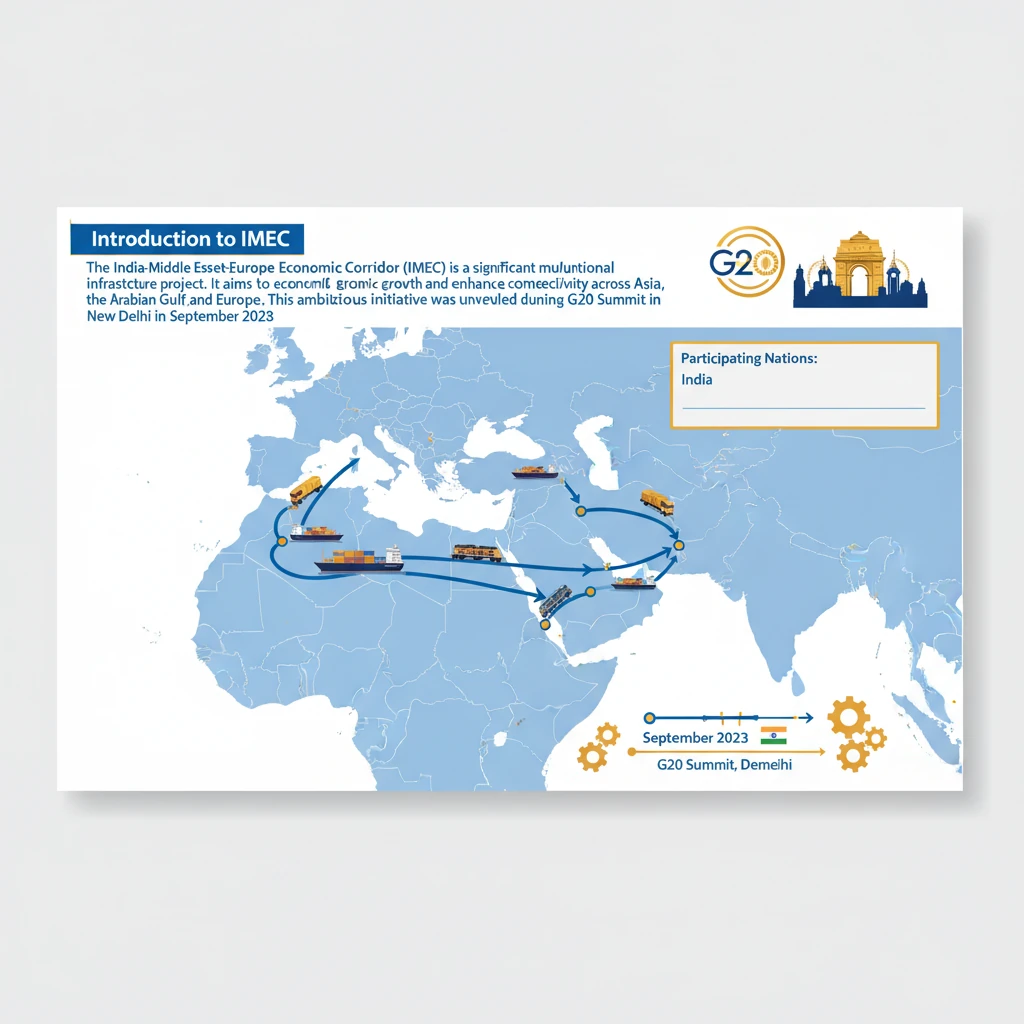
<h4>Introduction to IMEC</h4><p>The <strong>India-Middle East-Europe Economic Corridor (IMEC)</strong> is a significant multinational infrastructure project. It aims to foster economic growth and enhance connectivity across Asia, the Arabian Gulf, and Europe. This ambitious initiative was unveiled during the <strong>G20 Summit</strong> in <strong>New Delhi</strong> in <strong>September 2023</strong>.</p><div class='info-box'><p><strong>Participating Nations:</strong> The project involves India, the United States, Saudi Arabia, the United Arab Emirates, France, Germany, Italy, and the European Union.</p></div><h4>Objectives of IMEC</h4><p>IMEC's primary goal is to establish a reliable and cost-effective cross-border ship-to-rail transit network. This network will complement existing maritime and road routes, significantly reducing transit times and logistics costs.</p><p>It seeks to boost trade, facilitate the movement of goods and services, and strengthen economic ties among the participating countries. The corridor is envisioned as a catalyst for economic development and regional integration.</p><div class='key-point-box'><p><strong>Key Objectives:</strong></p><ul><li>Enhance <strong>connectivity</strong> and <strong>economic integration</strong>.</li><li>Reduce <strong>transit times</strong> and <strong>logistics costs</strong>.</li><li>Promote <strong>trade</strong>, especially in energy and digital communication.</li><li>Strengthen <strong>geopolitical influence</strong> and provide an alternative to existing corridors.</li></ul></div><h4>Components of the Corridor</h4><p>The IMEC project is broadly divided into two main corridors, integrating sea and rail routes to create a seamless transit system. This dual-corridor approach ensures comprehensive connectivity.</p><ol><li><strong>Eastern Corridor:</strong> Connects <strong>India</strong> to the <strong>Arabian Gulf</strong>. This segment primarily involves maritime shipping routes between Indian ports and ports in the UAE and Saudi Arabia.</li><li><strong>Northern Corridor:</strong> Links the <strong>Arabian Gulf</strong> to <strong>Europe</strong>. This segment combines rail networks through Saudi Arabia, Jordan, and Israel, connecting to European ports via maritime routes.</li></ol><div class='info-box'><p><strong>Infrastructure Focus:</strong> The corridor will include railway lines, port enhancements, and infrastructure for electricity cables, digital connectivity, and clean hydrogen pipelines.</p></div><h4>Significance for India</h4><p>For India, IMEC represents a strategic pathway to enhance its trade relations with the Middle East and Europe. It offers a direct and efficient trade route, bypassing traditional longer sea routes.</p><p>This corridor aligns with India's broader foreign policy objectives, including its <strong>'Look West' policy</strong> and its aspiration to become a global manufacturing and logistics hub. It also bolsters India's role in global supply chains.</p><div class='exam-tip-box'><p><strong>UPSC Insight:</strong> IMEC is crucial for understanding India's evolving <strong>geopolitical strategy</strong> and its efforts to diversify trade routes. It can be linked to topics in <strong>GS-II (International Relations)</strong> and <strong>GS-III (Economy, Infrastructure)</strong>.</p></div>
💡 Key Takeaways
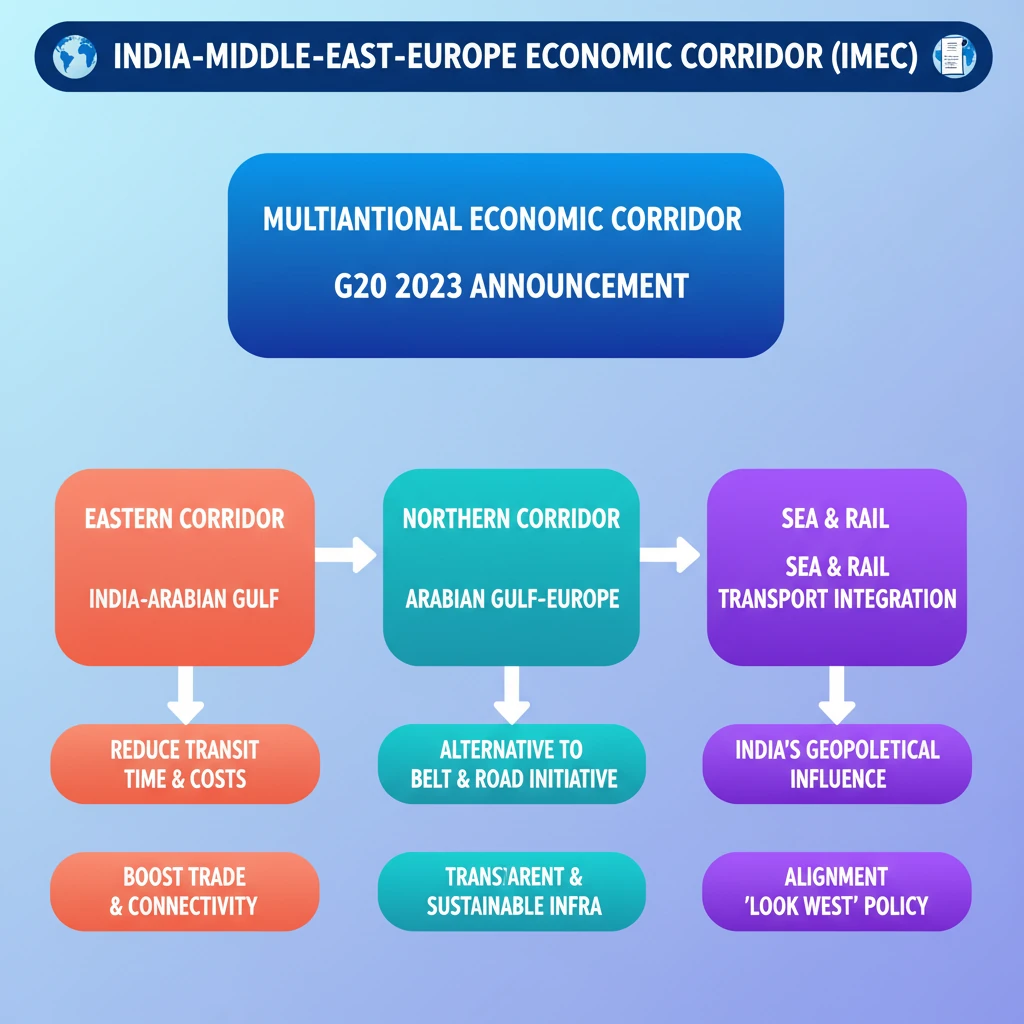
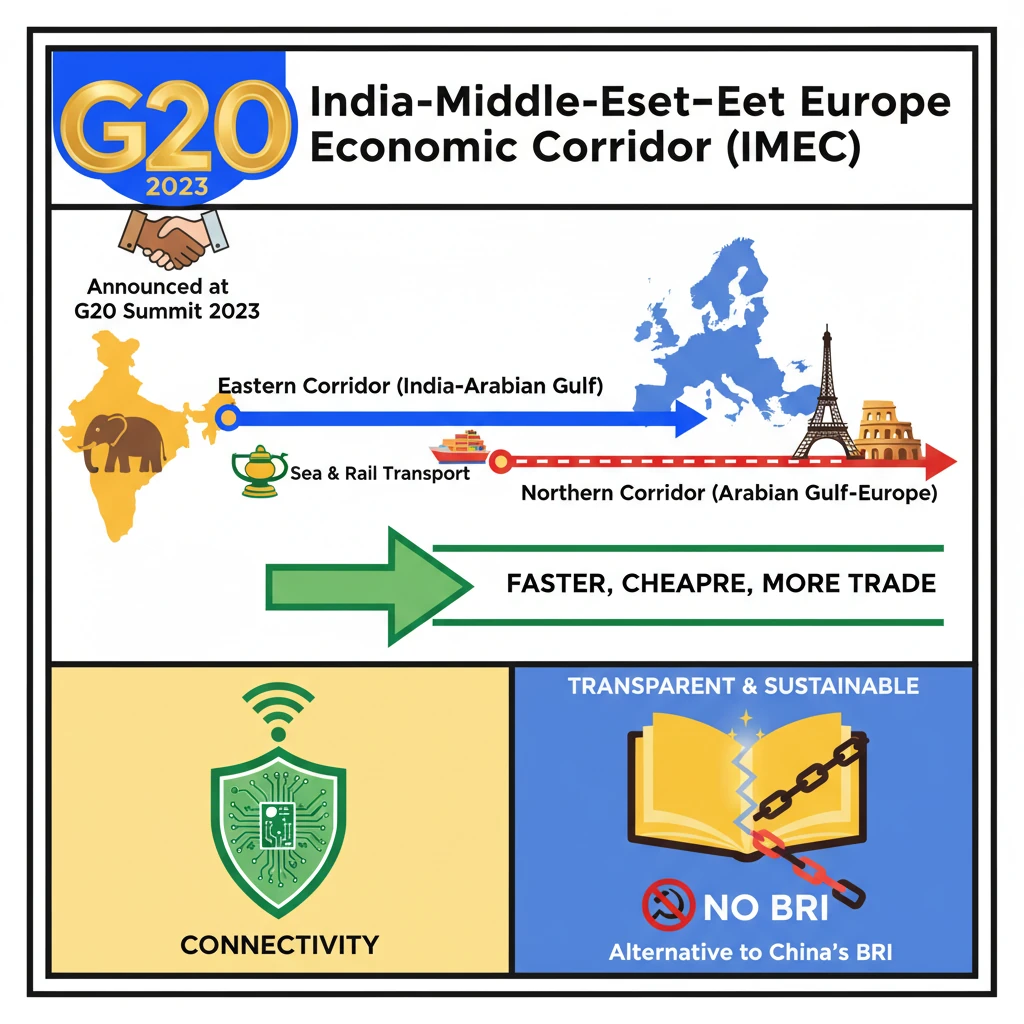
- •IMEC is a multinational economic corridor connecting India, the Middle East, and Europe, announced at the G20 Summit in 2023.
- •It comprises Eastern (India-Arabian Gulf) and Northern (Arabian Gulf-Europe) corridors, integrating sea and rail transport.
- •Objectives include reducing transit times, lowering logistics costs, boosting trade, and enhancing energy/digital connectivity.
- •It is seen as a strategic alternative to China's Belt and Road Initiative, promoting transparent and sustainable infrastructure.
- •For India, IMEC signifies enhanced trade routes, stronger geopolitical influence, and alignment with its 'Look West' policy.
- •The corridor aims to foster economic growth, regional integration, and resilience in global supply chains.
🧠 Memory Techniques
95% Verified Content
📚 Reference Sources
•G20 New Delhi Leaders' Declaration (September 2023)
•The White House (Official Fact Sheets on IMEC)
•European Commission (Statements on Global Gateway and IMEC)
•Reputable international news agencies (e.g., Reuters, The Hindu, Indian Express for G20 coverage)