30 YEARS OF TRIPS - economy | UPSC Learning
Topics
0 topics • 0 completed
🔍
No topics match your search
30 YEARS OF TRIPS
Medium⏱️ 8 min read
economy
📖 Introduction
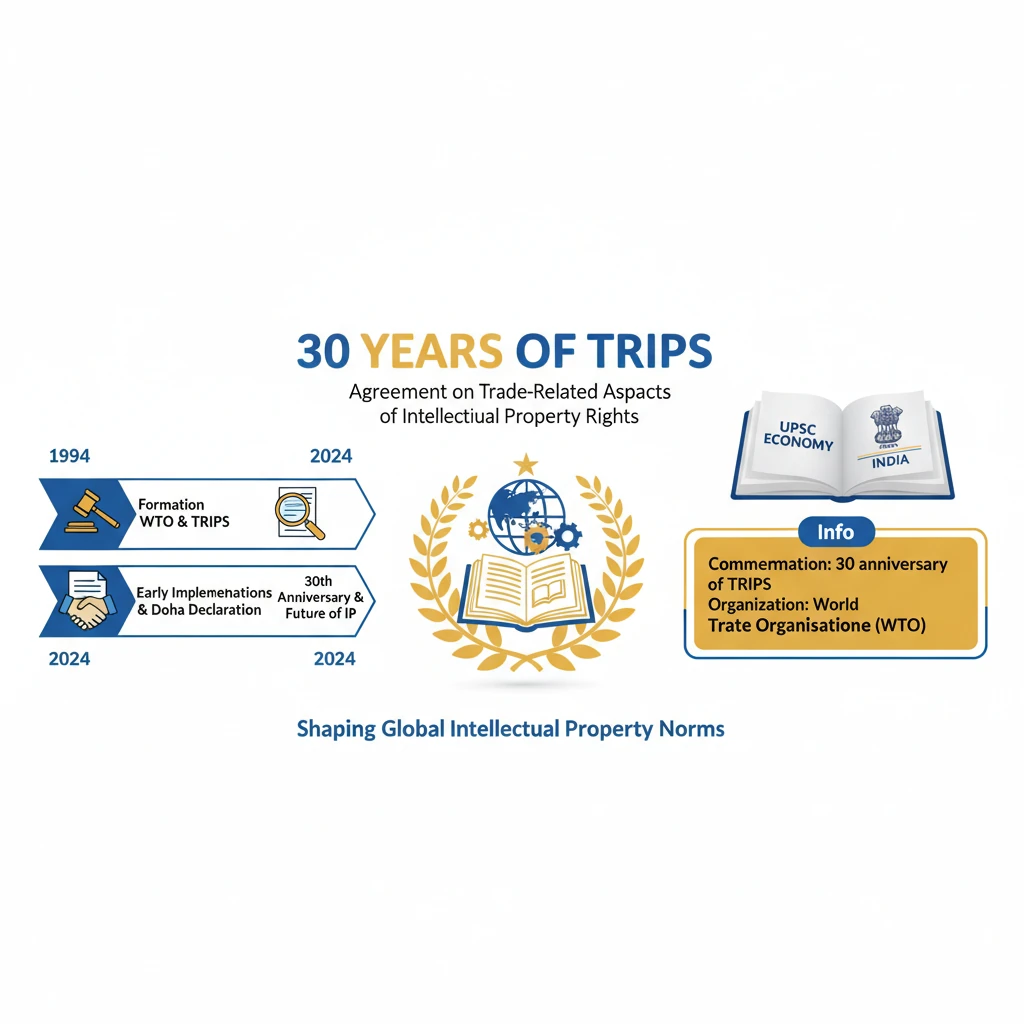
<h4>Introduction to the 30th Anniversary of TRIPS</h4><p>The <strong>World Trade Organisation (WTO)</strong> members recently commemorated the <strong>30th anniversary</strong> of the <strong>Agreement on Trade-Related Aspects of Intellectual Property Rights (TRIPS)</strong>.</p><p>This milestone highlights the enduring impact of a pivotal agreement forged three decades ago, shaping global intellectual property norms.</p><div class='info-box'><p><strong>Commemoration:</strong> 30th anniversary of the <strong>TRIPS Agreement</strong>.</p><p><strong>Organiser:</strong> <strong>World Trade Organisation (WTO)</strong> members.</p></div><h4>The Marrakesh Agreement and WTO Formation</h4><p>An important agreement made in <strong>Marrakesh</strong> helped create the <strong>WTO</strong> in <strong>1995</strong>. This foundational accord, known as the <strong>Marrakesh Agreement</strong>, also established the <strong>TRIPS Agreement</strong> as a core component.</p><p>The integration of intellectual property into the multilateral trading system through this agreement has had a long-lasting effect on global commerce and innovation.</p><h4>Understanding the TRIPS Agreement</h4><p>The <strong>WTO Agreement on TRIPS</strong> is recognised as the most <strong>comprehensive multilateral agreement</strong> on <strong>intellectual property (IP)</strong>. It sets minimum standards for the protection and enforcement of intellectual property rights.</p><div class='key-point-box'><p><strong>Key Concept:</strong> The <strong>TRIPS Agreement</strong> covers various forms of <strong>intellectual property</strong>, including patents, copyrights, trademarks, industrial designs, geographical indications, and trade secrets.</p></div><p>Its primary objective is to reduce distortions and impediments to international trade by ensuring adequate and effective protection of intellectual property rights among member countries.</p><div class='exam-tip-box'><p><strong>UPSC Insight:</strong> Understanding the origins, scope, and implications of <strong>TRIPS</strong> is fundamental for topics related to international trade, global governance, and India's position on intellectual property, frequently appearing in <strong>GS Paper II (International Relations)</strong> and <strong>GS Paper III (Economy)</strong>.</p></div>
💡 Key Takeaways
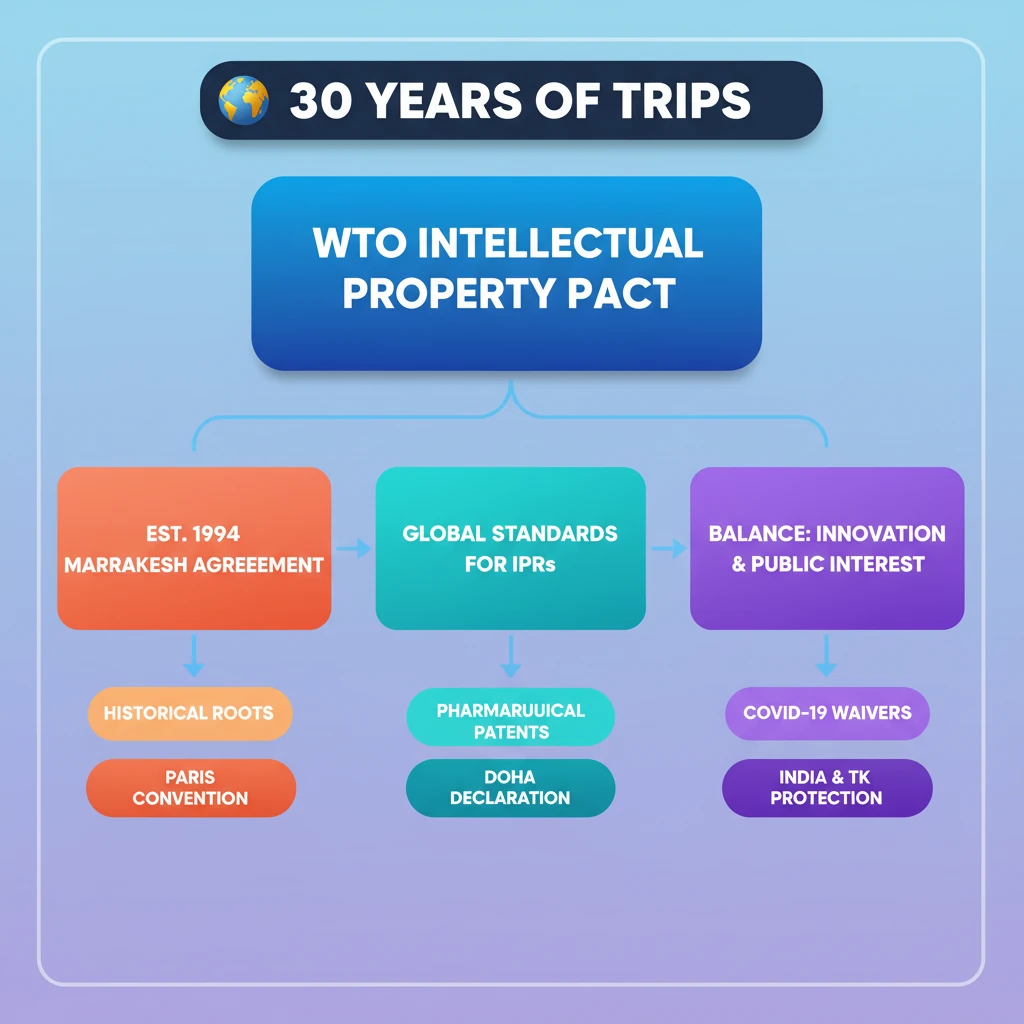
- •The TRIPS Agreement, a core pillar of the WTO, recently marked its 30th anniversary, established via the Marrakesh Agreement in 1994.
- •It is the most comprehensive multilateral agreement on Intellectual Property Rights (IPRs), setting minimum global standards for various IP forms.
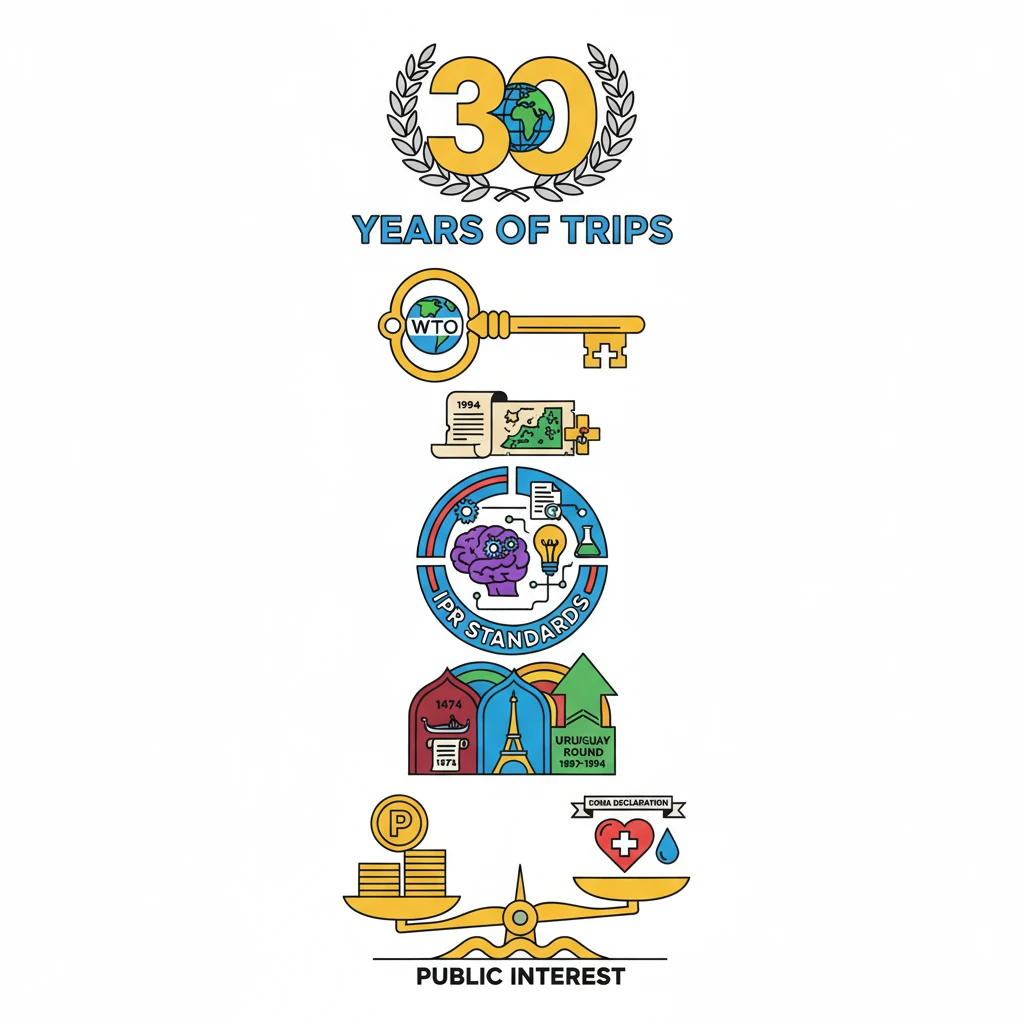
- •Its historical evolution traces back through the Venetian Patent Statute (1474), the Paris Convention (1883), and its integration during the Uruguay Round (1987-1994).
- •TRIPS aims to balance the rights of innovators with the public interest, a tension evident in debates over pharmaceutical patents and the Doha Declaration on Public Health.
- •Contemporary relevance includes discussions on COVID-19 vaccine waivers, technology transfer, and India's advocacy for traditional knowledge protection within the WTO framework.
🧠 Memory Techniques
95% Verified Content
📚 Reference Sources
•Drishti IAS - '30 Years of TRIPS' summary
•World Intellectual Property Organization (WIPO) - historical documents and publications on IP law