How are Mountains Formed? - geography | UPSC Learning
Topics
0 topics • 0 completed
🔍
No topics match your search
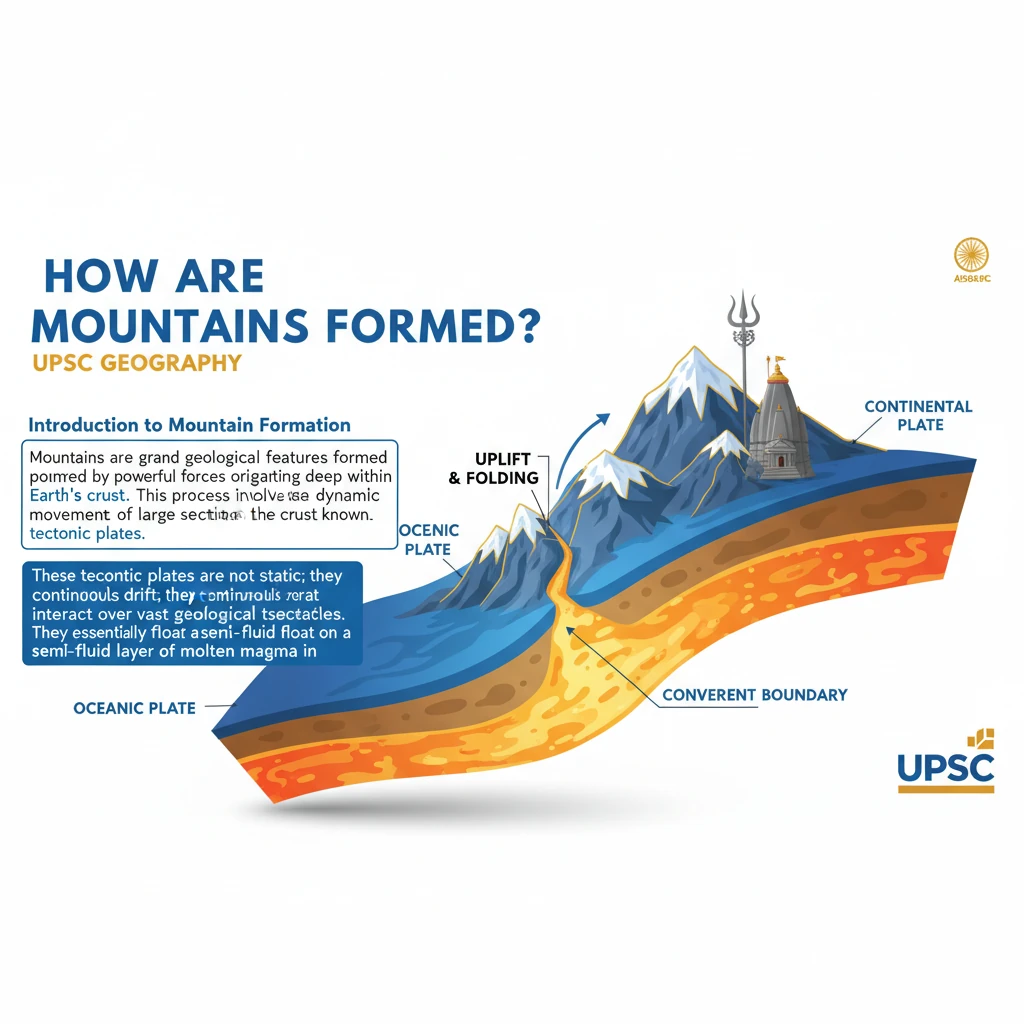
How are Mountains Formed?
Easy⏱️ 7 min read
geography
📖 Introduction
<h4>Introduction to Mountain Formation</h4><p>Mountains are grand geological features formed by powerful forces originating deep within the <strong>Earth’s crust</strong>. This process involves the dynamic movement of large sections of the crust known as <strong>tectonic plates</strong>.</p><p>These <strong>tectonic plates</strong> are not static; they continuously drift and interact over vast geological timescales. They essentially float on a semi-fluid layer of <strong>molten magma</strong> in the Earth's mantle.</p><p>The primary mechanism for mountain building occurs when these plates converge or collide. This intense pressure causes the Earth’s surface to either <strong>buckle</strong>, folding upwards, or <strong>protrude</strong>, being pushed upwards, ultimately creating mountains.</p><div class='key-point-box'><p><strong>Key Process:</strong> Mountain formation is fundamentally linked to <strong>plate tectonics</strong> and the immense forces generated at plate boundaries.</p></div><h4>Key Characteristics of Mountains</h4><p>Mountains possess several defining characteristics that distinguish them from other landforms.</p><ul><li><strong>Elevation:</strong> A crucial characteristic is their significant height. Mountains are generally much <strong>higher than the surrounding land</strong>, often exceeding an elevation of <strong>600 meters</strong> above sea level.</li><li><strong>Steep Slopes:</strong> Most mountains are characterized by their <strong>steep slopes</strong>, which can vary in gradient. While many are sharply inclined, some mountain flanks can be more gradual.</li><li><strong>Summit/Peak:</strong> The uppermost point of a mountain is referred to as its <strong>summit</strong> or <strong>peak</strong>. This is typically the highest elevation point of the individual mountain structure.</li><li><strong>Mountain Range:</strong> When a series or group of mountains are geographically connected by high ground, they form a larger geological unit known as a <strong>mountain range</strong>. Examples include the Himalayas and the Andes.</li></ul><div class='info-box'><p><strong>Definition:</strong> An <strong>orogeny</strong> refers to the process of mountain formation, particularly by the folding and faulting of the Earth's crust.</p></div><div class='exam-tip-box'><p>For UPSC, understanding <strong>mountain types</strong> (fold, block, volcanic, erosional) and their associated <strong>plate movements</strong> (convergent, divergent, transform) is crucial for both Prelims and Mains.</p></div>
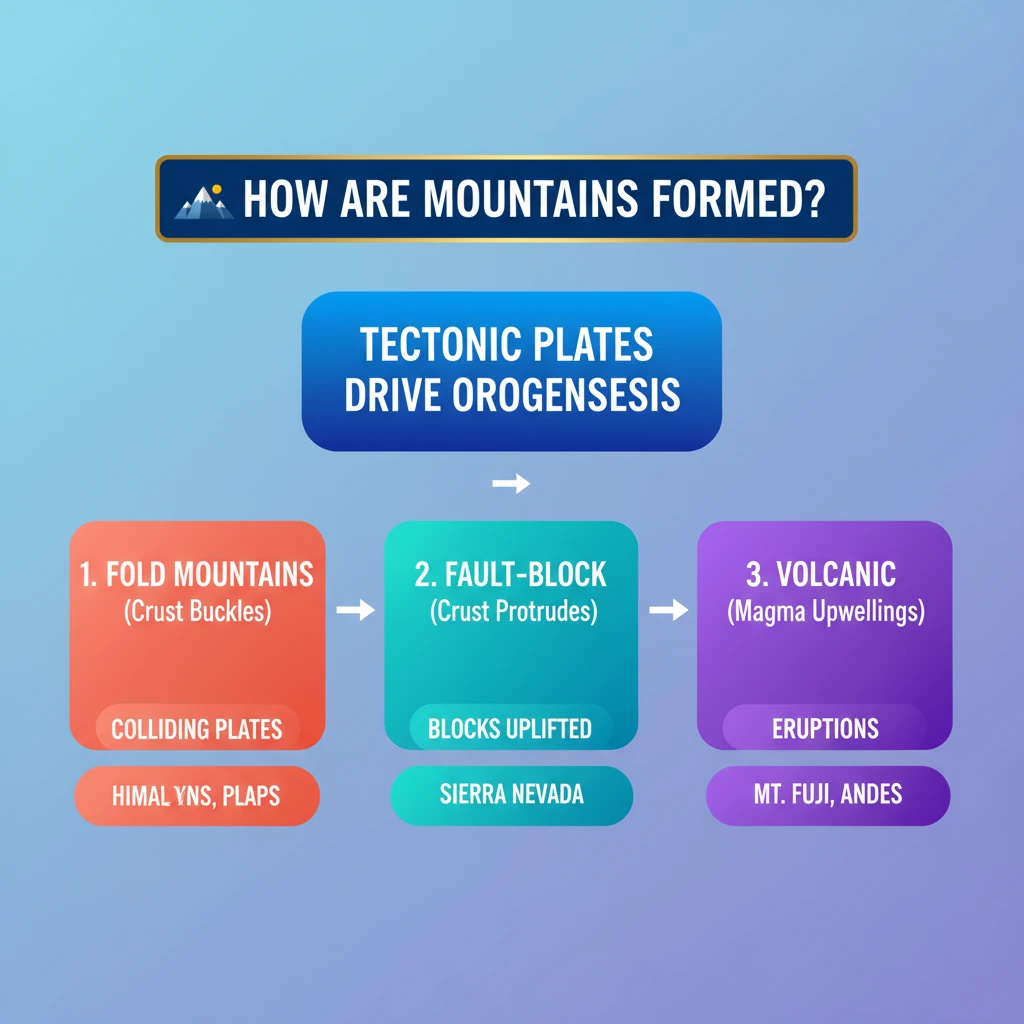
💡 Key Takeaways
- •Mountains are formed by the movement and collision of Earth's tectonic plates.
- •Plate interactions cause the crust to buckle, fold, or protrude upwards.
- •Key characteristics include high elevation, steep slopes, a summit/peak, and often occur in ranges.
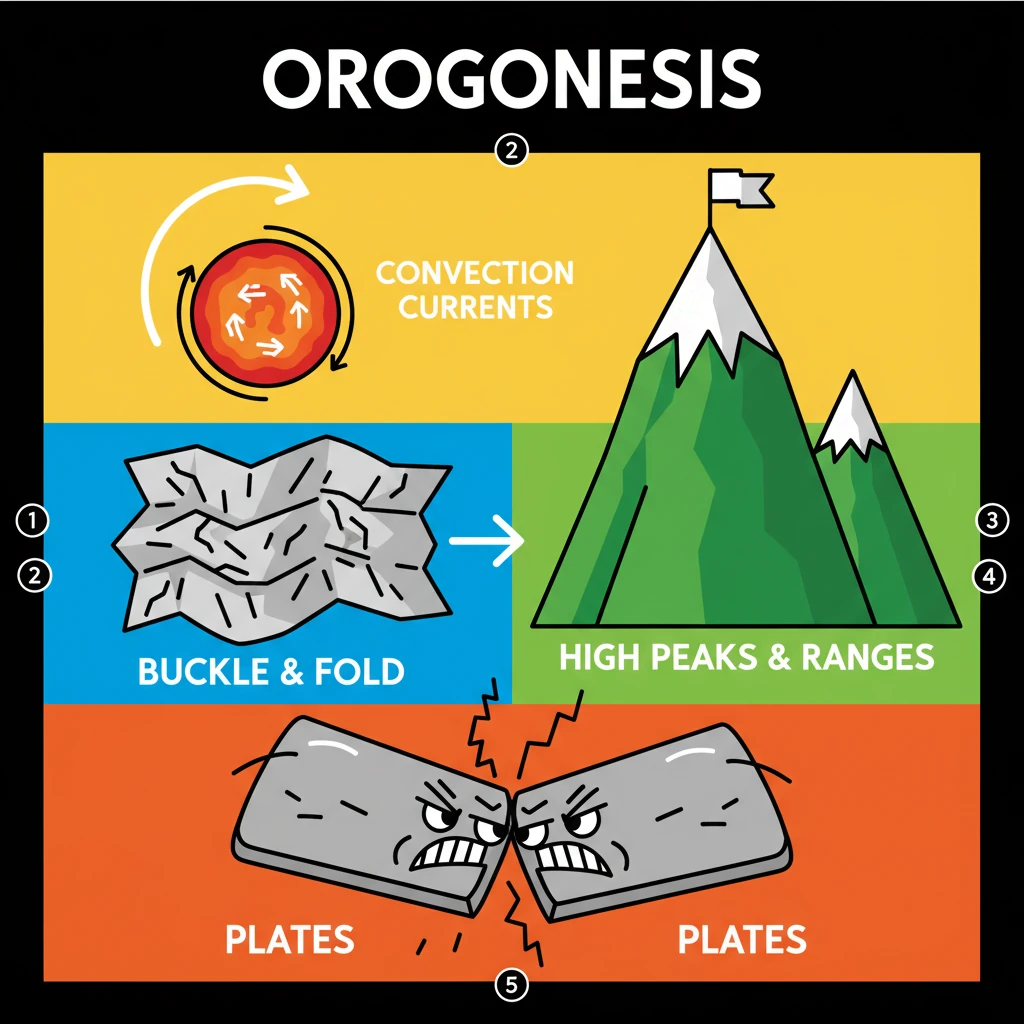
- •The process is called orogenesis, driven by convection currents in the mantle.
- •Understanding mountain formation is crucial for natural hazard assessment, resource location, and climate studies.
🧠 Memory Techniques
98% Verified Content
📚 Reference Sources
•NCERT Geography Textbooks (Class XI - Fundamentals of Physical Geography)
•Physical Geography by Savindra Singh
•Online geological resources (e.g., USGS, National Geographic)